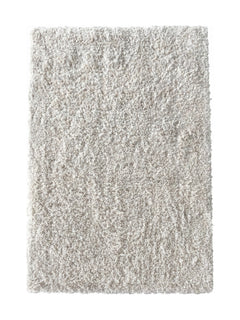
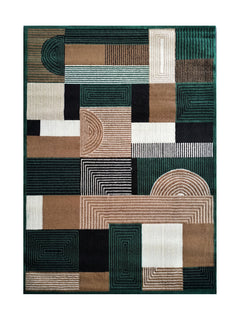
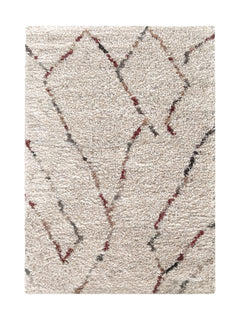
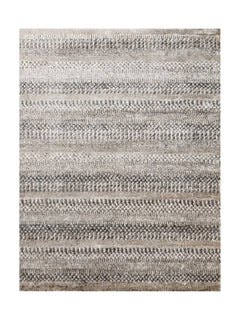
12 min read · Updated 4 May 2026
A living-room rug is rarely the first piece of decor people think of buying. It is, however, the one that does the most to structure the room: it marks out the living space, softens the acoustics, warms the floor and sets the tone for the whole scheme.
The wrong size makes a living room look smaller. A material that does not suit your daily life leaves you with regrets after six months. This guide runs through the seven points that genuinely make the difference when you are choosing a living-room rug, with the practical benchmarks that shop assistants rarely take the time to share.
1. Working out the right rug size for your living room
Size is criterion number one, ahead of style and colour. A rug that is too small looks like a postage stamp on the floor and visually shrinks the room. A rug that is too big swallows the space and gets in the way of movement. The rule that works in the vast majority of living rooms: leave 30 to 40 cm of visible floor between the rug and the walls.
1.1 The two-thirds rule under the sofa
The most reliable method is to place the two front feet of the sofa on the rug, which means roughly two thirds of the rug is covered by furniture. This arrangement creates a coherent visual zone without squeezing the circulation space. If your living room opens onto the dining room or the kitchen, go further than those two thirds and stand the whole sofa on the rug: that continuity is what creates the "large room" effect.
For a standard three-seater sofa (220 cm long), allow a rug that extends 45 to 60 cm beyond each end of the sofa. That gives you a minimum of 230 x 320 cm, more commonly found as a 200x300 format.
1.2 Standard sizes by living-room floor area
| Living-room area | Recommended rug | Ideal layout |
|---|---|---|
| Under 12 m² | 120x170 or 140x200 | In front of the sofa only |
| 12 to 18 m² | 160x230 | Front feet of the sofa on the rug |
| 18 to 25 m² | 200x300 | Two thirds of the sofa on the rug |
| 25 to 35 m² | 250x350 or 240x340 | Whole sofa plus one or two armchairs on the rug |
| Over 35 m² | 300x400 or larger | A complete living-zone effect |
The 160x230 format remains the best-seller for standard living rooms. For rooms of more than 20 m², go straight to a 200x300 format, which will transform how the space feels far more than a new sofa would.
1.3 A special case: a living room open to the kitchen or dining room
When the living room has no dividing wall, the rug becomes the real zoning tool. Choose a size that covers the whole sofa area without encroaching on the dining area, leaving 60 to 80 cm of breathing space between the two rugs if you put one under the table. A well-filtered living-room rug collection makes it easy to picture this logic before you buy.
2. Choosing the material to suit your lifestyle
The right rug is not the one that looks best in a photo: it is the one that will cope with your actual daily life. Before choosing, ask yourself three questions. Are there young children or pets in the house? Do you sometimes eat on the sofa? Is the living room a thoroughfare or a quiet room? Your answers point straight to the material.
2.1 Wool, viscose, Tencel, polypropylene, cotton: the comparison table
| Material | Feel | Machine washable | Ideal for |
|---|---|---|---|
| Wool | Dense, natural, warm | No, specialised cleaning | A quiet premium living room, built to last |
| Viscose | Very silky, lustrous | No, water damages it | A decorative living room without children |
| Tencel | Silky and matt, natural | No, gentle cleaning | An eco-conscious premium living room |
| Polypropylene | Matt, structured | Yes on the models concerned (check the product page) | Families, pets, heavy traffic |
| Polyester | Soft, matt | Yes on the models concerned (check the product page) | Busy households, modest budget |
| Cotton | Soft, flat | Yes on flat-woven models | A light living room, decor that changes often |
According to textile industry standards, the lifespan of a rug ranges from a few years for fine synthetic fibres to several decades for quality wool, provided it is looked after regularly. To explore premium models in wool, viscose and Tencel, see the handmade rugs collection.
2.2 Families with children or pets: why a washable rug changes everything
With young children or pets, a rug that cannot be washed quickly becomes a source of stress. One splash of juice, one hair worked into the pile, one claw mark on the fibres and the rug soon loses its looks. Casemira washable rugs are designed to go into a standard 7 to 10 kg domestic machine at 30 °C: stable polypropylene or polyester fibres, a washable non-slip backing, colourfast dyes. Four badges flag these qualities on the product pages: Machine Washable (30 °C cycle), Water-Repellent and Stain-Resistant (hydrophobic coating), Non-Slip (secure latex backing) and Scratch-Resistant. Models that combine all four carry the Easy Clean tag, made for repeated washing over time.
3. Matching the style to your sofa and your decor
Once size and material are settled, comes style. The golden rule: the rug and the sofa should have a conversation, not look the same. If your sofa is plain and neutral, allow yourself a rug with a pattern or a colour. If your sofa is patterned or very colourful, choose a plain textured rug to calm the composition. The worst choice is a beige sofa on a plain beige rug: the result falls flat and the room looks unfinished.
3.1 Rug and sofa: the golden rule of harmony
Think of the rug as the bassline of a track: it should give depth without competing with the main melody. Three combinations work almost every time:
- A pale linen sofa with an ivory Berber rug in black or sand motifs.
- A coloured velvet sofa (forest green, terracotta, midnight blue) with a plain textured tone-on-tone rug, two shades lighter.
- A dark leather sofa with a two-tone geometric rug (beige and black, or cream and taupe).
3.2 Four living-room rug styles to know in 2026
Warm minimalism is establishing itself in 2026 as the evolution of the strict minimalism of previous years. Colours: taupe grey, soft terracotta, ivory. Organic geometry (curves, ripples) rather than strict straight lines.
Dopamine decor relies on colourful, joyful rugs to lift the mood. One clear bright colour (saffron yellow, emerald green, Klein blue) on a neutral ground. The sofa stays quiet, the rug does the talking.
Japandi combines Japanese restraint with Scandinavian warmth. A handmade rug in wool or Tencel, very discreet motifs, a beige, sand and off-white palette. Ideal for a calm, light-filled living room.
The revisited classic marks the big comeback of modernised Berber and oriental rugs, in faded (vintage washed) palettes that sit happily in any contemporary interior. To explore the modernised Berber models in the catalogue, browse the Berber rug collection.
"The rug and the sofa should have a conversation, not look the same."
4. Rug colour: psychology, light and everyday marks
Colour tips the whole mood. A dark rug adds character and hides stains but reduces how bright the room feels. A pale rug visually enlarges the room but needs more regular care. Casemira offers 14 main colours (beige, white, blue, purple, green, red, grey, brown, black, gold, orange/terracotta, pink, multicoloured and ecru) to cover every mood.
4.1 Neutral colours or accent colours: how to decide
Neutrals (beige, grey, ivory, taupe) remain the most versatile choice: they go with any furniture and will survive a change of sofa in five years' time. Beige rugs and grey rugs are among the most requested references for a living room. If you are torn, go for a textured neutral (with relief or a tone-on-tone motif) to avoid a flat effect.
Accent colours (terracotta, midnight blue, forest green) ask for more commitment but transform a living room completely. A safe rule: the rug colour should pick up a colour already in the room (a cushion, a curtain, a vase, a picture) to create visual coherence. For the terracotta inspirations in high demand in 2026, see the orange and terracotta rugs.
4.2 Testing the material and the colour with a sample
A colour always looks different on screen, in a photo, and in your west-facing living room at 5pm. For some Handmade models, the Easy Clean range and a few outdoor rugs (more than 120 eligible references in the catalogue in total), Casemira offers a sample service: a 20 x 30 cm cutting of the exact material is delivered to your door. You can order up to 3 samples (€10 for one, €15 for two, €20 for three) with free delivery, and the amount is fully deducted from your rug with the code you receive by email.
For the other models in the catalogue that are not covered by the sample service, free returns within 30 days let you try the rug at home with no risk. You can explore the models available as samples in the sample collection.
5. How to spot a quality rug (density, finishing, certifications)
At equal size and style, two rugs can have life expectancies that differ threefold. Four technical criteria let you separate the wheat from the chaff without even touching the rug.
5.1 Density: the simple technical benchmark
Density is measured in grams per square metre (g/m²), or in knots per square decimetre for knotted rugs. The higher it is, the better the rug resists flattening and foot traffic. According to textile industry standards, there are three indicative levels:
- Low density: an occasional rug, light traffic.
- Medium density: a standard everyday rug, main living room.
- High density: a premium rug, often the handmade pieces in wool or wool plus Tencel.
A dense rug stays "full" underfoot, does not distort when you move a piece of furniture, and does not hold marks. For the exceptional pieces, the handmade rugs collection brings together more than 700 models in wool, viscose, Tencel or a blend.
5.2 Oeko-Tex Standard 100: what it guarantees
The Oeko-Tex Standard 100 certification is the essential health benchmark. It guarantees that the rug and all its components (fibres, dyes, non-slip backing, treatments) have been tested for the absence of harmful substances: formaldehyde, heavy metals, pesticides, azo dyes. It is a voluntary certification, paid for by manufacturers, and renewed every year. Many Casemira rugs carry Oeko-Tex Standard 100 certification. Check for the mention on the product page before buying if that criterion matters to you.
Beyond Oeko-Tex, look at three more things: the edge finishing (hand-sewn on premium pieces, cleanly overlocked on standard ones, frayed edges to avoid), the non-slip backing (present or not, washable or not), and the evenness of the tufting (tightly packed loops, no visible gaps).
6. Living-room rug budget in 2026: how much to set aside?
The Casemira catalogue covers a wide range, from small washable sizes at entry-level prices up to the most exclusive pieces (very large formats, premium handmade models, certain exceptional styles). To help you find your way, here are three concrete tiers:
Entry level (the smallest budgets): washable polypropylene or cotton rugs, sizes up to 160 x 230. Ideal for a rented flat, a first purchase, a secondary room or a room you redecorate often.
Mid-range (accessible premium): this is the most heavily represented bracket. Viscose, Tencel and wool-cotton blends, sizes from 160 x 230 to 200 x 300. Excellent durability-to-looks ratio for a main living room. Many models are Oeko-Tex certified.
Higher budgets (premium and handmade): handmade rugs, wool or fine blends, large formats. Pieces designed to last. The investment stacks up if you own your home and plan to stay more than five years.
Across the whole catalogue, delivery is free on orders of €100 or more (€9.99 below that). Payment is by card or PayPal. You also get free returns within 30 days: if the rug is not right for your room, sending it back costs nothing.
7. Caring for a living-room rug and how long it lasts
A well-cared-for rug lasts markedly longer than a neglected one. The habits that pay off:
- Vacuum regularly on the traffic areas, less often around the edges. Use the soft brush on wool rugs and viscose; a stiff rotating brush can damage delicate fibres.
- Turn the rug 180° every six months to spread the wear and avoid flattened patches under furniture.
- Deal with a stain straight away: blot without rubbing, using cold water for clear liquids, and avoid hot water, which can set the stain. For advice specific to your model, check the product page, which may set out the care suited to the material.
- Machine washing for models in the "Washable Rugs" collection: delicate programme at 30 °C, dry flat, never in the tumble dryer. Follow the exact recommendations on the product page.
- Occasional professional cleaning for wool, viscose or Tencel rugs: worth considering after several years of use, in line with the manufacturer's recommendations.
Three Casemira rugs for the living room
 Beige and Grey Berber Rug - Torino
 Grey & Anthracite Geometric Rug - Mirador
 Chocolate Brown 100% Wool Rug - Minho
Your questions about living-room rugs
What is the ideal rug size for a 20 m² living room?
For a 20 m² living room, the benchmark size is 200x300 cm. It lets you place the two front feet of the sofa on the rug while leaving around 35 cm of visible floor between the rug and the walls. That is the "large room" effect guaranteed, without squeezing circulation.
If your sofa is more than 240 cm long, or if the room opens onto the dining area, move up to a 240x340 or 250x350 format.
Which rug material works best with young children?
With young children, go for machine-washable rugs marked Easy Clean: all in polyester (mostly a polyester and cotton blend), machine washable at 30°C, water-repellent and stain-resistant, non-slip and scratch-resistant.
Avoid pure viscose (water damages it) and very pale wools (stains are hard to lift). Casemira washable rugs go into a standard domestic machine at 30 °C.
Can a living-room rug be used with underfloor heating?
Yes, as long as you choose a thin material that lets heat through. The materials that are often compatible are fine wool, cotton, Tencel and flat polypropylenes (with no long pile).
Avoid thick shaggy rugs and very dense rugs, which block the heat from spreading. Check the product page specifications for the words "compatible with underfloor heating" where they are stated.
How can I tell whether a rug is good quality before buying it?
Three criteria you can check on the product page:
1. Density: the higher it is, the better the rug resists flattening.
2. Oeko-Tex Standard 100 certification where it is mentioned, which guarantees the absence of harmful substances.
3. The edge finishing (sewn or cleanly overlocked).
On eligible models you can also order a sample, so you can feel the material in natural light before confirming your purchase.
How long does a living-room rug last?
Lifespan depends on the material and on care. According to textile industry standards, a light cotton or an entry-level polyester lasts a few years, while quality wool or a well-cared-for handmade piece can go on for several decades.
What extends life the most is turning the rug 180° every six months and vacuuming regularly. A premium living-room rug is a lasting investment, not a consumable.
Can you buy a living-room rug without seeing it in person?
Yes, by securing the purchase on two levels:
1. For the more than 120 models eligible for the sample service (some of the handmade rugs, the Easy Clean range and a few outdoor rugs), order the material as a 20 x 30 cm piece to check the colour and texture at home.
2. For all the other models, take advantage of free returns within 30 days.
Our customer service team replies to every email within 24 working hours: contact@casemira.com.
Written by the Casemira team. Our team, based in Brittany, selects more than 1,500 rugs to help you find the one that suits you. Find out more about Casemira.