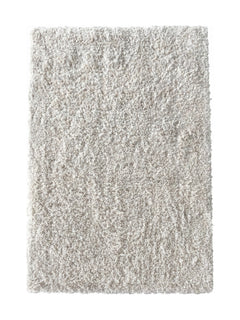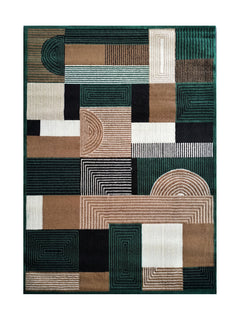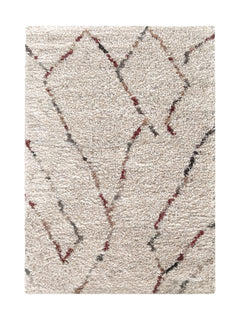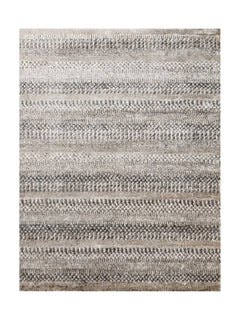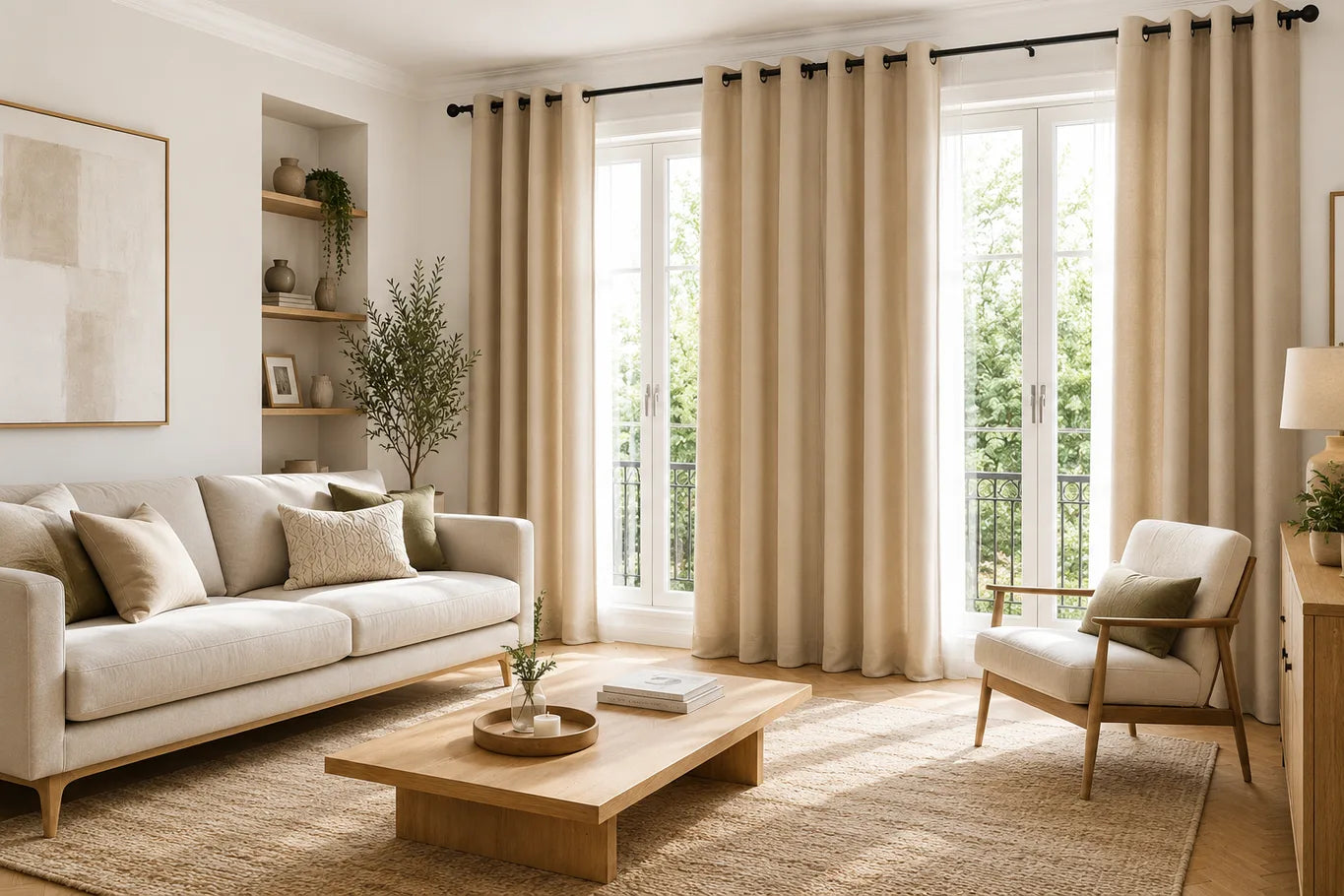
Matching your rug to your curtains gives a room its structure and creates visual continuity between the floor and the windows. In a living room as much as in a dining room, these two elements take up a great deal of decorative space: paired well, they help create a balanced, welcoming interior.
Colours, patterns, materials or sizes: a handful of simple principles will help you find the right pairing without overloading the room.

In short
- Settle on a coherent colour palette, either tone on tone or with contrasts you keep under control.
- Pair a patterned rug with plain curtains, and the other way round.
- Match materials and sizes to the room and the way you use it.
The fundamental rules for pairing rugs and curtains with taste
Pairing a rug with curtains rests above all on a balance between colours, patterns and materials. The aim is not necessarily to choose textiles that match perfectly, but to create enough echoes to hold the whole scheme together.
Settling on a coherent colour palette for your room
Colour makes a good starting point. Two approaches work particularly well:
- Tone on tone: work through one colour family in different shades. A sand beige rug paired with natural linen curtains creates a soft, luminous mood, for instance.
- Contrast: pair colours that differ but complement each other. A navy blue rug can be teamed with pearl grey or ecru curtains to add depth.
Think about the colour of the sofa and the main pieces of furniture too. With a forest green, terracotta or deep blue sofa, more neutral textiles will keep the whole scheme balanced.
Pairing a patterned rug with plain curtains
To avoid a visually overloaded room, it is better to decide which element dominates.
If your rug carries strong geometric, Berber or floral motifs, go for plain curtains. They will bring texture to the windows without competing with the rug's design.
Conversely, if your curtains have stripes or bold patterns, choose a plain or lightly textured rug instead.
A few cushions can then act as the link between the two: simply pick up one of the rug's secondary colours on the sofa.

Playing with texture: from velvet to natural fibres
Harmony is not only a matter of colour. Textures also add depth to a decorative scheme.
For a natural or Scandinavian mood, a jute, sisal or wool rug sits easily alongside linen or cotton curtains.
For a cosier interior, you can favour more generous materials, such as a plush rug teamed with heavy curtains.
So the aim is not necessarily to use the same material, but to choose textures that answer one another.
Which should you choose first: the rug or the curtains?
There is no compulsory order. It all depends on which element places the most constraints on your room.
Starting from the rug to build your scheme
A rug often covers a large surface in a living room or a dining room. When it comes in a strong colour or with bold patterns, it can serve as the starting point: pick up one of its shades on the curtains or on a few accessories.
In a dining room, the rug also marks out the space set aside for the table.
Starting with the curtains and blinds to manage light
Starting with the curtains or the blinds makes particular sense when managing light or privacy is your priority.
- Look at how the window is oriented and decide how much filtering you want: diffusing, blackout or room-darkening.
- Then choose the right window dressing. A roller blind, ideally made to measure for the window, suits contemporary interiors particularly well, while curtains bring more texture and warmth.
- Finally, bring the rug into line with the colours and texture you have chosen for the windows.
Adapting the pairing to the room
The same choices will not necessarily suit a living room and a dining room. Practical constraints have to be taken into account as well.

| Criterion | Living room (relaxing) | Dining room (entertaining) |
|---|---|---|
| Type of rug | Plush or textured | Flat weave or natural fibres |
| Window dressing | Curtains, voiles or blinds | Roman blinds, roller blinds or curtains |
| Priority | Comfort and atmosphere | Easy care and practicality |
In a dining room, above all allow for a rug big enough to let the chairs be pulled back without immediately leaving its surface. A flat-weave design will also be easier to look after day to day.
In the living room the constraints are different: a more generous rug helps mark out the seating area and creates a cosier feel.
The mistakes to avoid with rugs and curtains
A few mistakes can quickly unbalance a scheme, even when the colours and materials are well chosen.
Choosing a rug that is too small
A rug that is too small easily looks as though it is "floating" in the middle of the room.
In a living room, go for a size that at the very least lets the front feet of the sofa sit on the rug. It also needs to keep proportions that make sense against the width of the furniture.
In a dining room, it has to be generous enough to take the table and the chairs.
Hanging curtains that are too short
The length of the curtains has a strong influence on the final result.
To keep a handsome vertical line, the fabric can:
- stop just above the floor for a crisp hang;
- reach floor level for a skimming hang;
- rest lightly on the floor for a break at the hem.
Made to measure is precisely what lets you fit the curtain drop to the real dimensions of the window and to the effect you are after.
Piling up colours and patterns
Finally, harmony means neither matching everything nor multiplying the effects.
A graphic rug, floral curtains and several striped cushions risk making the whole scheme hard to read. At the other extreme, using exactly the same colour everywhere can fall flat.
One simple rule is therefore to choose a visually dominant element, then use the other textiles to support it.
Finding the right balance between rugs and curtains
A successful pairing ultimately rests on three things: colours, materials and proportions.
The rug can serve as the starting point for the scheme, while the curtains and blinds also answer needs for light and privacy. What matters is creating continuity between the floor, the windows and the furniture without trying to match everything.
By choosing one dominant element and quieter textiles to accompany it, you will end up with an interior that is coherent, welcoming and easy to live in.
 Black & Gold Washable Rug 11 - Onyx
 Navy Shaggy Washable Rug - Sahel
 Light Beige 100% Wool Rug - Vektor