7 min read · Updated 25 May 2026
Beige has dominated interiors searches for twenty years, for one simple reason: it is the most versatile shade in the neutral palette. But behind that slightly catch-all word sits real subtlety, in the form of undertones. Choosing a beige rug without understanding that family risks a pink-leaning beige on a red floor, a yellow beige facing an ochre wall, or a washed-out cream that vanishes in daylight. This guide gives you the markers to turn a beige rug into a signature piece, with real references from the Casemira range (104 designs available, from €34 to €1,589).
1. Why beige is still the safe bet
Beige is the forgiving shade. It gets on with every timber, from pale Scandinavian oak to dark mid-century walnut. It flatters cognac leather, brushed brass and veined marble. It calms bright colours without smothering them, warms north-facing rooms and visually stretches small spaces. Above all, it ages well: a well-chosen beige rides out the trends, while a strongly styled rug can look dated by the following season.
On the practical side, it is also the colour that best hides everyday life. A mid beige swallows dust, crumbs and footmarks better than off-white or charcoal does. For a busy living room or a child's bedroom, that is a concrete advantage.
2. The 5 undertones of beige
Beige comes in five broad families. Identifying yours is the first step, before you look at a single design. Ask yourself one simple question: does your interior lean warm (yellow or red floors and timbers) or cool (greys, cool whites, black metal)? The answer points straight to an undertone.
| Undertone | Character | When to choose it | Casemira examples |
|---|---|---|---|
| Warm sand | Soft, sunlit, slightly orange | North-facing rooms, pale floors, when you want warmth | Sahel round shaggy in sand, the Valore beige and brown designs |
| Luminous cream | Leaning towards off-white, very pale | Small spaces, Scandinavian schemes, brightening a room | Sahel round in cream, Ravello plain beige, Quieto cream (handmade) |
| Deep taupe | A darkened beige, almost brown, elegant | Mid-century living rooms, hushed schemes, contrast against pale walls | Dante beige and brown, Torino design in beige and brown |
| Natural ecru | A broken beige, slightly grey, absolutely neutral | Japandi, contemporary minimalism, pale timber | Arcano modern beige, Isadora vintage beige |
| Greyed linen | A beige leaning towards pearl grey, sophisticated | Period flats, pared-back contemporary rooms, herringbone floors | Mirador round in cream and grey, Mirador beige and grey |
A quick practical test: lay a sheet of white paper on your floor, then a beige sample next to it. If the sample looks yellow, the undertone is sand. If it looks grey, it is linen. If it looks brown, it is taupe. That simple check heads off the most common mistake, which is assuming a beige is neutral when it already carries an underlying tone.
On the handmade designs and the Easy Clean washables (a selection of 127 references), Casemira offers samples at €10, deducted in full when you buy, with no limit per household.
3. What to pair a beige rug with
The golden rule: avoid full tone-on-tone. A beige sofa on a beige rug against a beige wall reads flat, with no relief at all. Beige needs a point of contrast to show what it can do. Here are the five most effective pairings, tested across hundreds of room sets:
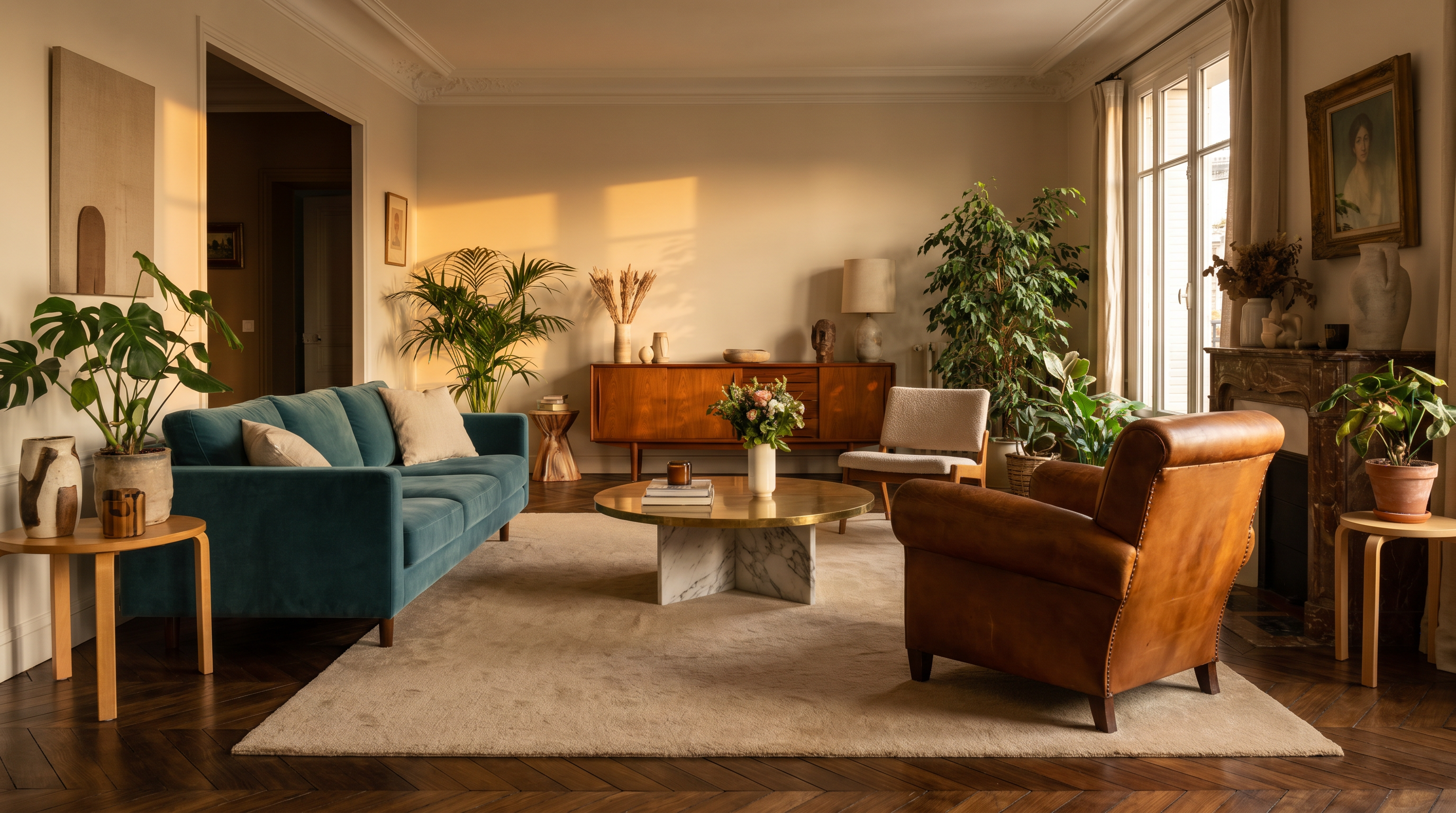
Cognac leather with sand beige: the mid-century pairing par excellence, and especially good on a dark wooden floor. Patinated leather amplifies the warmth of the sand, and the beige softens the leather's contrast.
Teal or forest green velvet with cream beige: a contemporary art deco duo. Cream beige acts as a backdrop that lets the depth of saturated velvet do its work.
Veined white marble with linen beige: a high-end period pairing. The grey veining in the marble talks to the grey undertone in the linen, creating a subtle visual coherence.
Black metal with taupe beige: an industrial loft look. The severity of black metal finds its calm in the depth of taupe, which is warmer than charcoal.
Dark walnut with sand or cream beige: a japandi classic. The contrast between the depth of the walnut and the softness of a pale beige structures the room without cutting it in half.
To go further on colour harmony, our guide to choosing a rug colour covers the 60-30-10 rule and warm versus cool undertones.
"Beige is not an absence of colour. It is the ground that lets everything else speak."
4. Scandinavian beige: pared back and bright
Scandinavian schemes call for a pale beige, close to off-white. Nordic thinking favours light, pale oak or beech, white walls and natural textiles. The rug then works as a visual and acoustic buffer without breaking that pale coherence.
Three practical routes into this look:
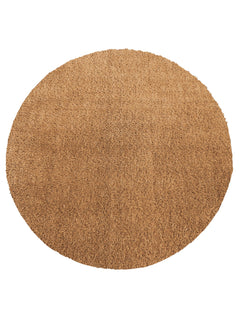
First, the round cream shaggy (the Sahel design at Casemira, €34 at 80 cm diameter, up to €119 at 160 cm). Its deep pile brings the plush comfort typical of Nordic interiors while staying neutral. A round format is ideal in front of a two-seater sofa, in a reading corner, or in a child's bedroom.
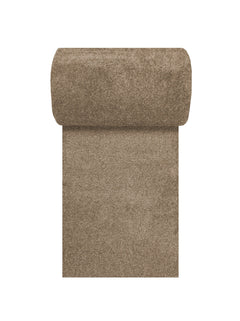
Next, the plain pale beige rectangle, such as the Ravello (plain, €34 to €225 depending on size). Its smooth surface and 2,400 g/m² density (per the product page specifications) make it a safe choice for an open-plan living room. Choose 160×230 or 200×300 depending on the size of your living room.
Finally, a faded vintage motif, such as the Isadora or the Vision, which adds a little relief without breaking the restraint. This is the option for anyone who finds a plain rug too clinical.
5. Boho and Mediterranean beige
Boho and Mediterranean schemes like a warm beige, sand or taupe, paired with terracotta, ochre, plum or olive green accents. Here the rug brings the pattern, often drawn from Berber style or from ethnic compositions.
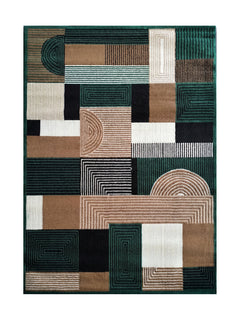
In this register, Casemira has several relevant entry points. The Valore designs combine a beige ground with contemporary oriental motifs in BCF polypropylene, robust and accessible (from €34 in the smaller sizes). The Torino designs take a geometric beige and brown motif in a more contemporary direction. For bigger commitments, the handmade rug collection offers 58 hand-tufted references in wool, viscose or Tencel, in sand, cream and taupe tones, from €349.
The boho trick: layer a smaller, darker Berber rug over a large plain beige one. This creates visual depth and lets you play with pattern without saturating the room.
6. Modern, minimalist beige
Minimalist modern schemes are after purity of line. A beige rug there needs to be plain, or very discreetly textured, in a linen or ecru undertone that flirts with grey. Geometric motifs are allowed, as long as they stay restrained: Mirador in beige and grey, the modern Arcano, or the handmade Quieto designs with their very subtle gradations.
In this style, size counts as much as colour. A large beige rug taking in the whole living room (200×300 as a minimum, ideally 300×400 for a 25 m² room) gives the space structure. A small beige rug floating between the sofa and the coffee table gives the game away immediately, and that is the classic failure of the 20 cm rule.
On materials, minimalist modern schemes are unforgiving of overly shiny polypropylene. Choose matt surfaces, virgin wool, or Tencel and cotton blends that catch light without bouncing it back. Our guide to choosing a rug material sets out the options by budget.
At the very top end, the Persian collection includes a few Samara designs on beige and cream grounds in 100% Modal Silk (silk-effect acrylic, density up to 3,000,000 knots per m², made in Turkey), priced around €984. An exclusive, long-lasting living room piece that outlives the trends.
7. Common mistakes to avoid
Mistake 1: pairing a yellow beige with a yellow wall. A very warm sand undertone against ochre or pale yellow walls creates a uniform yellowish field with no relief. The fix: move to a linen or ecru beige that contrasts with the wall's warm undertone.
Mistake 2: using the same beige throughout the room. A beige sofa plus beige curtains plus a beige rug plus beige walls gives you airport hotel. You need at least one point of contrast: coloured furniture, a feature wall, or strong decorative objects.
Mistake 3: forgetting the floor's undertone. A reddish floor (cherry, red-varnished beech) calls for a neutral or linen beige, never a pinkish sand that amplifies the red. Conversely, a grey floor or cool tiling needs a warm beige to bring the temperature up.
Mistake 4: buying too small. A beige rug that is too small simply disappears. Beige needs a generous surface to work. See our guide to choosing a rug size.
Mistake 5: overlooking upkeep. A pale beige rug shows marks sooner. In higher-risk areas (a living room with children, a dining room), choose machine washable designs or the Easy Clean references (a selection of 57 designs within the washable collection).
Three Casemira rugs for the living room
 Shaggy Beige Rug - Prismo
 Modern Beige Rug - Quieto
 Oval Wool & Viscose Rug - Ambra
8. FAQ: beige rugs
Your questions about beige rugs
Which beige undertone should I pick if I have no idea where to start?
Warm sand beige is the most versatile undertone. It works with pale and dark timbers alike, with white or coloured walls, and with grey or brown floors. If your interior already leans clearly cool (grey tiling, black metal, white lacquered furniture), switch to ecru or linen.
Do beige rugs get dirty quickly?
No more than any other rug, provided the material is well chosen. BCF and heat-set polypropylene fibres are naturally stain-resistant, so particles stay on the surface and vacuum away easily. For heavy use, go for the 57 Easy Clean designs in the washable range, which combine machine washability with water-repellent stain resistance, a non-slip backing and scratch resistance.
Which material works best for a beige rug?
For comfort and durability, wool remains the benchmark by textile industry standards. For budget and easy upkeep, heat-set or BCF polypropylene is unbeatable. For a silky finish and elegance, Tencel or viscose in a blend. The full guide is here.
Can you put a beige rug on tiles?
Yes, with no restrictions. A light non-slip underlay improves grip on a smooth surface. Rugs with a latex backing (which most Casemira washable designs have) grip tiles naturally with no extra accessory.
What size beige rug for a living room?
For a 15 m² living room, aim for 160×230. For 20 m², 200×300. For 25 m² and above, 250×350 or 300×400. The 20 cm rule under the sofa remains the reference: full guide here.
Are there round or oval beige rugs?
Yes. Casemira offers 6 round designs and 6 oval designs in beige, from the round Sahel shaggy in cream or sand (€34 at 80 cm) to the plain round Ravello and the vintage Mirador round in cream and grey. An ideal shape in front of a two-seater sofa or in a reading corner.
Written by the Casemira team, based in Brittany. More about Casemira.