10 min read · Updated 8 May 2026
Not all rugs are equal, and price alone is a poor judge. At the same size and in the same style, two rugs can have life expectancies that differ threefold, colours that hold or fade, and a handle that stays full or flattens after six months.
The good news is that a rug's quality shows up in technical clues anyone can read, as long as you know where to look. This guide runs through the seven points that really make the difference when choosing a hard-wearing, well-made rug.
1. The 4 quality criteria a savvy buyer looks at
Before getting into the detail, here is the framework that structures the whole article. Four criteria are enough to judge a rug's quality without ever touching it.
1.1 The overview: material, density, finishing, certification
The first criterion is the material: wool, viscose, Tencel, polypropylene, polyester, cotton or a blend. Every material has its own lifespan curve and its own resistance to flattening. The second criterion is density, which measures how much fibre there is per square metre and determines how sturdy the rug is. The third criterion is the finishing of the edges, the backing and the evenness of the tufting: three immediate visual clues. The fourth criterion is certification, in particular Oeko-Tex Standard 100, which guarantees the absence of harmful substances.
The four criteria have to be read together rather than in isolation: a dense rug made from basic generic polypropylene will never match a moderately dense rug made from premium wool.
1.2 Why price on its own is never enough
A rug's price depends on so many factors (size, material, hand or machine production, brand, retailer margin) that comparing two rugs on price alone leads to regular mistakes. A handmade wool rug can be a better ten-year buy than a machine-tufted wool rug that costs half as much, because the longer lifespan absorbs the initial difference. Conversely, an inexpensive washable polypropylene rug can make far more sense than a premium handmade piece in a household with two toddlers. The right price is the one that matches how you will actually use the rug, not the highest figure in the catalogue.
2. Density: the simple technical benchmark
Density is the criterion that separates two rugs made from the same material most clearly. The higher it is, the better the rug resists flattening, footfall and distortion over time.
2.1 g/m² for tufted rugs, knots/dm² for knotted rugs
Density is expressed in two units depending on the production technique. For tufted rugs (machine or hand), we measure the weight of fibre per square metre in grams per square metre (g/m²). For hand-knotted rugs (the traditional Persian or oriental technique), we count the number of knots per square decimetre (knots/dm²) or per square inch (KPSI). The higher the figure, the denser the rug.
2.2 Low, medium and high density: what each one means
Textile industry standards recognise three indicative levels. Low density is typical of occasional rugs and decorative pieces in low-traffic spots. Medium density covers the standard everyday rugs found in most French living rooms. High density belongs to premium pieces, often handmade rugs in wool, viscose, Tencel or a fine blend. Casemira product pages state the figure whenever the information is available. For the densest pieces in the catalogue, browse the handmade rug collection.
2.3 The thumb test: feeling quality with your hand
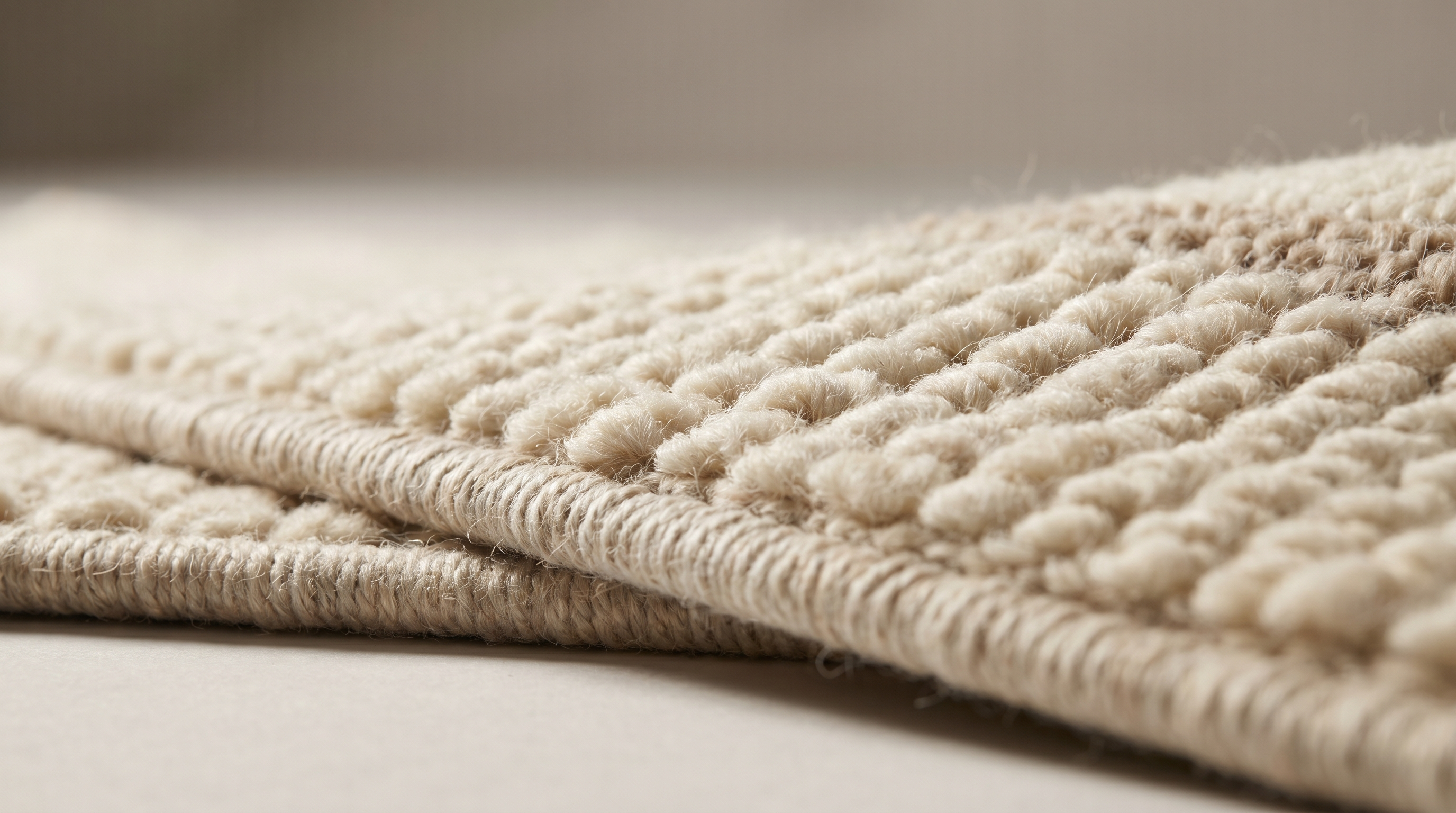
If you can physically touch a rug (at home after delivery, or at a friend's house if they own a similar model), one simple test reveals a great deal. Place your thumb on the surface of the rug and press firmly for a few seconds. On a dense rug, the thumb sinks very little and the fibre springs straight back to its original position when you let go. On a low-density rug, the thumb sinks easily and leaves a visible mark that takes a while to disappear. Repeating the test on the edges of the rug, which are more fragile, confirms the overall quality.
3. Material matters as much as density
High density in a poor material gives you a rug that feels full but wears out quickly. Conversely, medium density in a good material can give you a rug that lasts several decades. The right reflex is to assess material and density together.
3.1 Wool, viscose, Tencel: the premium fibres
Wool is the historic noble fibre of rug making. Naturally hard-wearing, elastic and insulating both thermally and acoustically, it flattens very little and keeps its volume over time. Viscose offers a very silky, lustrous handle close to silk at a far lower cost, ideal for decorative rugs that will not see intensive daily use. Tencel is an eco fibre made from cellulose: soft, matt and more stable than viscose when it meets water (though that does not make it washable). All three fibres are found mainly in premium handmade rugs. To explore that range, browse the handmade rug collection, which brings together more than 700 designs.
3.2 Premium polypropylene vs entry-level polypropylene
Not all polypropylenes are equal, and this is the material where the quality gap is widest. Premium polypropylene (often called heat-set or frisé, sometimes BCF) mimics the feel of wool, keeps its volume over time and, on the models that allow it, takes a machine wash without damage. This is the version used in the Casemira catalogue. The Easy Clean range, for its part, is made of polyester (mostly a polyester and cotton blend) and combines four treatments on every design: machine washable at 30°C, water-repellent and stain-resistant, non-slip, and scratch-resistant. An entry-level generic polypropylene, by contrast (not stocked by Casemira), can be thinner, less dense and quicker to lose its lustre under furniture.
3.3 Blends: fine fibre or compromise?
Many rugs combine several fibres to get the best value for money. Wool and viscose pairs the strength of wool with the sheen of viscose. Wool and Tencel adds softness and stability. Polyester and polypropylene is a common synthetic blend, sturdy and affordable. To judge a blend, read the percentage of each fibre: an "80% wool, 20% viscose" rug is far more hard-wearing than a "20% wool, 80% viscose" rug, where the wool is little more than a marketing label.
4. Visible finishing: the detail that gives quality away
At comparable material and density, the finishing is what separates a well-made rug from a sloppy one. Three areas are worth inspecting: the edges, the tufting and the backing.
4.1 Hand-sewn, overlocked or fraying edges
The hand-sewn edge is the premium standard: a thick thread stitched by hand around the perimeter of the rug to hold the fibres in place and stop any fraying over time. It is the immediate marker of a quality handmade rug. The overlocked edge is an even machine stitch: the correct standard for good machine-tufted rugs. A fraying edge, or one that is simply glued, is a warning sign: the rug will start shedding fibres within the first few months.
4.2 Even tufting and pattern alignment
On the face of the rug, check that the tufting is even: no visible dips, no tufts standing higher than the rest, no lighter patches revealing a lack of fibre. On patterned rugs (geometric, Persian, Berber), check that the patterns are crisp and aligned, with no distortion. A blurred or skewed motif points to careless tufting. The best rugs have a perfectly crisp design even at close range.
4.3 The non-slip backing and how well it is bonded
The backing of a rug tells you a great deal. On a handmade rug, the backing should be clean and even, with a visible woven cotton canvas and, where present, a natural or synthetic latex film applied uniformly. On a machine-tufted rug, the backing should be flat and solid, with no air pockets and no patchy areas of exposed glue. On washable rugs, the non-slip backing should be supple rather than brittle, and suitable for the washing machine. Avoid rugs whose backing crackles under your fingers: it is a sign of poor quality, or of an old rug stored in the wrong conditions.
“A rug is judged underfoot before it is judged by eye.”
5. The certifications worth checking (and those that are not)
Textile certifications are numerous and far from equal. A few offer a genuine consumer guarantee, others are marketing in disguise.
5.1 Oeko-Tex Standard 100: the health benchmark
The Oeko-Tex Standard 100 certification is by far the most relevant for a rug. It guarantees that the rug and all its components (fibres, dyes, non-slip backing, treatments) have been tested for the absence of harmful substances: formaldehyde, heavy metals, pesticides and azo dyes. It is a voluntary certification, paid for by manufacturers, and renewed every year. Many Casemira rugs carry Oeko-Tex Standard 100 certification. Check for the mention on the product page before buying if this criterion matters to you, particularly for a child's bedroom.
5.2 GUT, BLAUER ENGEL and other textile labels
Other labels exist in the textile world. GUT (Gemeinschaft umweltfreundlicher Teppichboden) is a German label specific to carpeting and rugs, certifying low chemical emissions and recyclability. BLAUER ENGEL (the Blue Angel) is a general-purpose German environmental label applied to some eco-conscious rugs. The EU Ecolabel is the European equivalent, and rarer on rugs. These labels add environmental and end-of-life guarantees on top of Oeko-Tex, but they are seldom found in mainstream rug catalogues.
5.3 When the absence of a label does not mean poor quality
A rug can be perfectly safe and hard-wearing without carrying any label at all, simply because the maker has not gone through the certification process (which costs several thousand euros per design). That is often the case with artisanal handmade rugs, where small-batch production does not justify the investment. Conversely, a rug carrying a little-known label (created by the manufacturer itself or by an obscure association) guarantees nothing. The rule: Oeko-Tex Standard 100 remains the most reliable universal benchmark, but its absence does not disqualify a rug whose material and finishing are visibly good.
6. Handmade vs machine-tufted: the real differences
The distinction between handmade rugs and machine-tufted rugs is often debated. Both can be good, but the two techniques produce very different objects.
6.1 How to spot a genuine handmade rug
Three clues will identify a true handmade rug. First, the backing: you can see the stretched cotton canvas and the fibres passing through it one by one, with slight irregularities that prove a human hand was involved. Second, the edges: hand-sewn with a thick, clearly visible thread. Third, controlled evenness: the rug is regular but not mechanically perfect, with micro-variations in pile height or pattern alignment that give handmade pieces their charm. The Casemira handmade rug collection brings together more than 700 designs.
6.2 Hand-knotted, hand-tufted, machine-tufted: the technical hierarchy
Three main techniques share global production. The hand-knotted rug uses the most traditional method (historically oriental): every knot is tied by hand on a vertical loom, taking weeks or months of work for a single piece. The hand-tufted rug is made with a hand-held tufting gun: faster than knotting while keeping a strong artisanal element. The machine-tufted or machine-woven rug is mass-produced on industrial machines: quick to make, affordable, with quality that varies from one maker to another. At Casemira, the handmade pieces (in wool, viscose, Tencel or a blend) can be found in the handmade rug collection.
7. Testing quality before you pay
Judging a rug's quality on a screen has its limits, even with excellent product photography. Casemira offers two complementary services to make your choice safer before you commit.
For some Handmade designs, the Easy Clean range and a few outdoor rugs (more than 120 eligible references in total across the catalogue), Casemira offers a sample service: a 20 x 30 cm cutting of the exact material is delivered to your door. That lets you assess density, evenness of the tufting and the feel of the pile before ordering the full rug. You can order up to 3 samples (€10 for one, €15 for two, €20 for three) with free delivery, and the amount is deducted in full from your rug with the code you receive by email. See the eligible designs in the samples collection.
For the other designs in the catalogue that are not covered by the sample service, free returns within 30 days let you test the rug's quality at home with no risk. If the rug you receive does not match your expectations (density, finishing, colour), you send it back free of charge within 30 days. Our customer service team is available by email at contact@casemira.com and replies within 24 working hours, so you can get advice before you buy. To go further on choosing a rug for your living room, read our guide to choosing a living room rug.
Three Casemira rugs
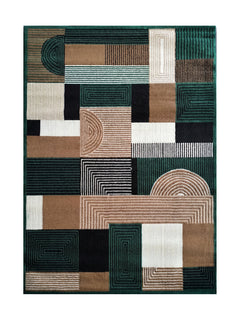
 Green & Beige Oriental Rug - Valore
 Brown Oriental Rug - Riviera No. 04
 Yellow & Grey Geometric Washable Rug - Skyline
A 6-point checklist to run online
Before clicking “Buy”, six points should be checked on the product page:
| # | What to check | Quality indicator |
|---|---|---|
| 1 | Material composition | Clear mention of the main fibre (wool, viscose, Tencel, polypropylene, polyester, cotton, Modal Silk) |
| 2 | Density | g/m² or knots/m² listed in the specifications. The denser the rug, the longer it lasts |
| 3 | Oeko-Tex certification | Standard 100 = no harmful substances. Essential for bedrooms and family living rooms |
| 4 | Country of manufacture | Country stated (Turkey, India, Poland and so on). Missing information is a red flag |
| 5 | Properties | Washable, non-slip, water-repellent, scratch-resistant (depending on intended use) |
| 6 | Purchase guarantees | Is a sample available? How many days to return? Who pays the return costs? |
How Casemira presents them: every Casemira product page covers these six points in the expandable Specifications section. Exact composition, density in g/m², origin, properties (Washable, Non-Slip, Water-Repellent, Easy Clean and Oeko-Tex tags), Sample button (on more than 120 eligible designs) and the mention of 30-day returns. It is all readable without hunting for it.
Red flags to walk away from
Five signals that should make you think twice about a purchase:
Vague or missing composition. If the page just says “modern rug” without naming the fibre, be suspicious. Any serious brand states at least the main material.
Undeclared origin. No country of manufacture means no traceability. Casemira always states the origin (India and Morocco for handmade rugs, Turkey for Persian-style rugs, and so on).
Missing or unusually low density. For a handmade wool rug sold at a premium price, a density below 1500 g/m² is suspicious. Compare it against textile industry standards.
No Oeko-Tex certification on a bedroom or family living-room rug. For everyday living spaces with children or pets, certified freedom from harmful substances has become a standard.
A vague or paid-for returns policy. A brand that makes returns difficult (charges, short windows, opaque conditions) is showing a lack of confidence in its own product. Casemira offers free returns within 30 days with no special conditions across 100% of the catalogue.
Bonus: a price that is abnormally low for the material claimed. A handmade wool 200 x 300 priced like an entry-level rug does not exist in the real premium market. If the offer looks too good, check the technical detail.
Transparency about compositions
The first checkable signal before any purchase: does the brand clearly state the material composition of every design?
What a serious product page contains as a minimum:
- Precise composition in percentages (e.g. 75% NZ wool, 15% viscose, 10% cotton)
- Origin (country of production)
- Production method (hand-tufted, machine-tufted, flatwoven, jacquard-woven)
- Density or weight of the rug (qualitative at the very least, ideally a figure)
- Underfloor heating compatibility (yes / no)
- Backing (latex, cotton, jute and so on)
- Care instructions (vacuuming, washing, stain removal)
The warning signs, conversely:
- Vague composition ("synthetic fibre" with no percentage)
- No origin mentioned
- No information about the backing
- No specific care instructions
At Casemira, every product page in our catalogue of more than 1,500 designs states the composition in percentages, the origin, the density (as a figure or qualitatively), the backing, underfloor heating compatibility and the care instructions. On density in particular, see rug density in g/m²: the key indicator.
The commercial guarantees
Commercial guarantees shape the buying experience more than the decoration itself. Four of them are worth checking every time.
A clear returns policy. The brand should state a precise window (the legal minimum is 14 days for distance selling, but a serious brand goes further), a cost (free, ideally) and the exact conditions (condition of the product, packaging). At Casemira, you get free returns within 30 days of receipt, more than double the legal minimum. See our returns and refunds policy.
Samples available. Being able to test the material before buying a large format cuts the risk considerably. At Casemira, we offer up to 3 samples of 20 x 30 cm from €10 with free delivery, deducted from your rug with the code you receive by email. They are available on a selection of more than 120 designs (some of the handmade rugs, the Easy Clean range and a few outdoor rugs). See the samples collection and the guide on how to order a sample.
Clear payment. A rug is often a larger purchase, so the payment options should be obvious before you reach the checkout. At Casemira, you pay by card or PayPal.
Transparent delivery. Costs, lead times, carriers: everything should be stated before you complete your order. At Casemira, you get free delivery on orders of €100 or more (€9.99 below that) and dispatch within 24 to 48 working hours, then delivery in about 2 to 8 working days depending on the country. See our delivery policy.
Your questions about rug quality
What minimum density is recommended for a main living-room rug?
For a main living room that sees regular footfall, aim for medium to high density depending on the material.
On rugs tufted in premium polypropylene, medium density is fine. On wool rugs, high density is what you should expect. On handmade pieces in wool or a fine blend, density is generally very high by construction.
Is Oeko-Tex Standard 100 compulsory?
No, it is not a legal requirement. It is a voluntary certification that the manufacturer chooses to pursue or not.
Its presence guarantees the absence of harmful substances, which is particularly reassuring in a child's bedroom. Its absence does not mean a rug is dangerous: many artisanal handmade rugs are perfectly safe without the label.
Is there a rug brand universally recognised as a mark of quality?
No. The rug market does not work like watchmaking or leather goods: there are no global brands unanimously seen as shorthand for quality.
Quality is judged on technical criteria (density, material, finishing, certifications), not on the maker's name.
What is the real difference between a hand-knotted rug and a hand-tufted rug?
A hand-knotted rug is made knot by knot on a vertical loom, a traditional technique that takes weeks or months of work per piece.
A hand-tufted rug is made with a tufting gun held by a craftsperson, which is faster. Genuine hand-knotted rugs are rare and expensive; hand-tufted pieces are more affordable.
What is a reasonable price for a rug that lasts?
It depends entirely on size, material and technique. A premium washable polypropylene rug in 160x230 generally sits at the accessible end of the range, and each product page shows the exact price of every size.
A hand-tufted rug in wool or a fine blend in 200x300 sits much higher. The most exclusive pieces can run to several thousand euros.
Is a sample really useful for judging a rug's quality?
Yes, especially for confirming the material and the density. A 20 x 30 cm cutting lets you feel the fibre, test how it springs back after pressure, and judge the fineness of the tufting and the quality of the backing.
On the eligible designs (more than 120 references: some of the handmade rugs, the Easy Clean range and a few outdoor rugs), the sample costs from €10, deducted in full from your rug with the code you receive by email.
Written by the Casemira team. Based in Brittany, our team curates more than 1,500 rugs to help you find the one that feels like you. Find out more about Casemira.