7 min read · Updated 3 July 2026
On any serious rug product page you will find a figure given in g/m² (grams per square metre). That is the density of the rug, and it is probably the most telling indicator after the material composition. You just need to know how to read it. Many buyers make the mistake of comparing an outdoor polypropylene with a handmade wool piece on their respective g/m², without realising that the two do not move on the same scale. Here is how to decode it.
1. What density in g/m² actually is
Density in g/m² measures the amount of textile material contained in one square metre of rug. In practice, if you weighed a piece of the rug measuring exactly one square metre, you would get its g/m².
Three elements contribute to the density:
- The weight of the upper fibre (the visible pile, the surface yarn): the largest component.
- The weight of the base weave (the structure that carries the fibre).
- The weight of the backing (secure latex on non-slip designs, or the weave alone on handmade pieces).
The higher the density, the more material the rug contains for the same surface. Broadly, that means more fibre per mm² (so finer motifs become possible), more mechanical resistance to footfall and a longer service life according to textile industry standards.
But be careful: a high g/m² is not an absolute sign of quality. A fine, precise rug can be excellent with fewer g/m² than a thick, fluffy rug of lesser quality. The g/m² always has to be read in the context of its category.
2. How it is measured
Measuring density in g/m² is standardised according to textile industry standards:
- A precise sample of the rug (typically 100 x 100 cm = 1 m²) is cut.
- The sample is conditioned in a climate chamber for 24-48 hours.
- The sample is weighed on precision scales.
- The weight divided by the area (1 m²) gives the g/m².
For handmade pieces, the measurement can vary by 5-10% between two samples of the same rug. For machine production, it is very consistent.
Casemira states the density in g/m² in the specifications section of most product pages. On designs where the exact density is not given, the page states the material composition and the pile height.
For a full read of spec sheets before buying, see our guide to checking the quality of a rug before you buy.
3. Density vs pile height
Two complementary but distinct measurements:
Pile height (mm). The vertical measurement of the rug:
- Low (5-8 mm): easy to look after, family living room, heavy footfall
- Medium (8-12 mm): a balance of comfort and upkeep, the standard
- Long (15-30 mm): shaggy, lovely under bare feet, more demanding to care for
Density (g/m²). The measurement of total material per 1 m²: how much material there is per unit of surface.
The two are not correlated. A very dense low pile rug can have a higher g/m² than a sparse long pile one.
To assess a rug, look at both measurements together:
- Low height (5-8 mm) plus a high density for the category = a dense, fine rug built to last
- Long height (15-30 mm) plus a high density for the category = a quality shaggy
- Long height plus a low density = a fluffy shaggy that will not last as well
- Low height plus a low density = a light, thin rug with a typical service life
"Density is not read in absolute terms. It is read within its category."
4. Benchmarks by category of use
This is the key point: density is read by category, not in absolute terms. Each category of rug has its own density range, coherent with its use and its manufacturing technology.
| Category | Typical range according to textile industry standards | Use |
|---|---|---|
| Outdoor polypropylene rug | Varies by design, optimised for water drainage and UV resistance | Terrace, balcony, pergola. A light fibre can be more appropriate outdoors than a dense one (it dries quickly) |
| Kitchen and bathroom rug | Varies by design, prioritising machine washing plus a latex backing | Damp areas, heavy footfall. Density is judged alongside how long the latex backing lasts |
| Indoor polypropylene rug | A fairly wide range across designs, from light to very dense | Family living room, bedroom, corridor. Density depends on the visual effect and the budget |
| Easy Clean rug (polyester, mostly a polyester and cotton blend) | Density optimised for the four combined treatments | Family living room, pets. Density calibrated for repeated washing |
| Handmade wool or blended rug | A range favouring medium to high density across designs | Refined living room, main bedroom. Density contributes to a 15-25 year service life |
| Persian rug (Modal Silk, acrylic-cotton) | Density given in points/m² rather than g/m² | A signature piece. A different measurement, tied to the fineness of the motif |
The key point: a low g/m² within a category can be entirely appropriate for its use. Some outdoor rugs, for instance, deliberately use a light fibre so they dry quickly after rain; comparing them with a handmade wool piece makes no sense.
Each design's own page is the reference: it gives the specific density and lets you compare with other designs in the same category. Never compare across categories.
5. g/m² density vs points/m² density (Persian)
For Persian rugs, a different measurement is used: the weaving density in points per m². Across the Casemira Persian rug collection, every design reaches 3,000,000 points per m². See Persian rugs: high density explained.
Why that measurement rather than g/m² for a Persian rug?
A Persian rug aims for maximum fineness of motif. Points/m² measures that fineness directly: the higher it is, the more precisely the motifs appear. The g/m² would simply measure the total weight, which does not capture that qualitative dimension specific to Persian rugs.
Approximate equivalences according to textile industry standards:
| Density in points/m² | Category |
|---|---|
| 200 000 - 500 000 | Basic machine-made rug |
| 500 000 - 1 000 000 | Standard machine-made rug |
| 1 000 000 - 1 500 000 | Good-quality machine-made rug |
| 3 000 000 | Premium contemporary Persian rug (the Casemira Persian collection) |
The takeaway: g/m² and points/m² cannot be compared. The g/m² is the standard measurement across most of the catalogue. Points/m² is the specific measurement for premium Persian rugs.
6. How to read a Casemira product page
On Casemira product pages, density is documented in the expandable Specifications section. Here is how to interpret it:
Step 1: identify the category. Is the rug outdoor, kitchen or bathroom, indoor polypropylene, Easy Clean, handmade or Persian? The category is given by the collection it belongs to.
Step 2: read the stated density. The g/m² (or points/m² for a Persian rug) is given wherever the information is available.
Step 3: compare within the category. When comparing two designs, stay inside the same category.
Step 4: cross-check with other indicators. Density plus material composition plus Oeko-Tex certification plus pile height plus properties together give the full picture.
For a selection of more than 120 designs, a sample from €10 (free delivery, cost deducted from your rug through the code you receive by email) lets you feel the density physically in your hand.
On designs that are not eligible, free returns within 30 days apply across 100% of the catalogue. See Easy Clean rugs, handmade rugs and high-density Persian rugs.
Three Casemira rugs for the living room
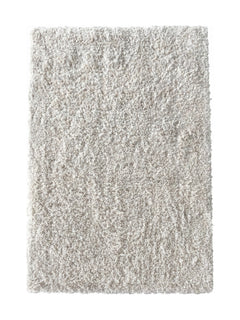
 Beige & Grey Contemporary Rug - Verona
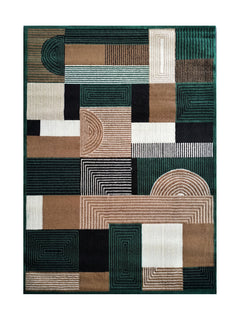
 Caramel & Brown Oriental Rug - Valore
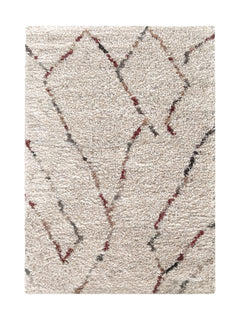
 Ivory 100% Wool Rug - Sentiero
7. FAQ: density in g/m²
Your questions about density in g/m²
Does a high density always mean better quality?
No, not in absolute terms. Density has to be read by category. An outdoor rug that deliberately uses a light fibre is right for its purpose. Comparing across categories makes no sense.
How do you compare the density of two rugs?
Always within the same category. Two handmade pieces together. Two Easy Clean designs together. Two outdoor rugs together. Then cross-check with material composition, pile height and certifications.
What is the density of the Casemira Persian range?
All the designs in the Casemira Persian collection reach 3,000,000 points per m². See Persian rugs: high density explained.
Density or pile height, which comes first?
The two are complementary. Height determines the feel. Density determines the strength and the service life. Cross-check both within the same category.
Is the density always given on a Casemira product page?
On most Casemira pages, the density appears in the expandable Specifications section. If it is missing, contact customer service by email at contact@casemira.com.
Can I test the density before buying?
A selection of more than 120 designs is available as a sample from €10 (free delivery, cost deducted from your rug through the code you receive by email), so you can feel the density physically. On the others, free returns within 30 days make the at-home test risk-free.
Written by the Casemira team, based in Brittany, France. Find out more about Casemira.