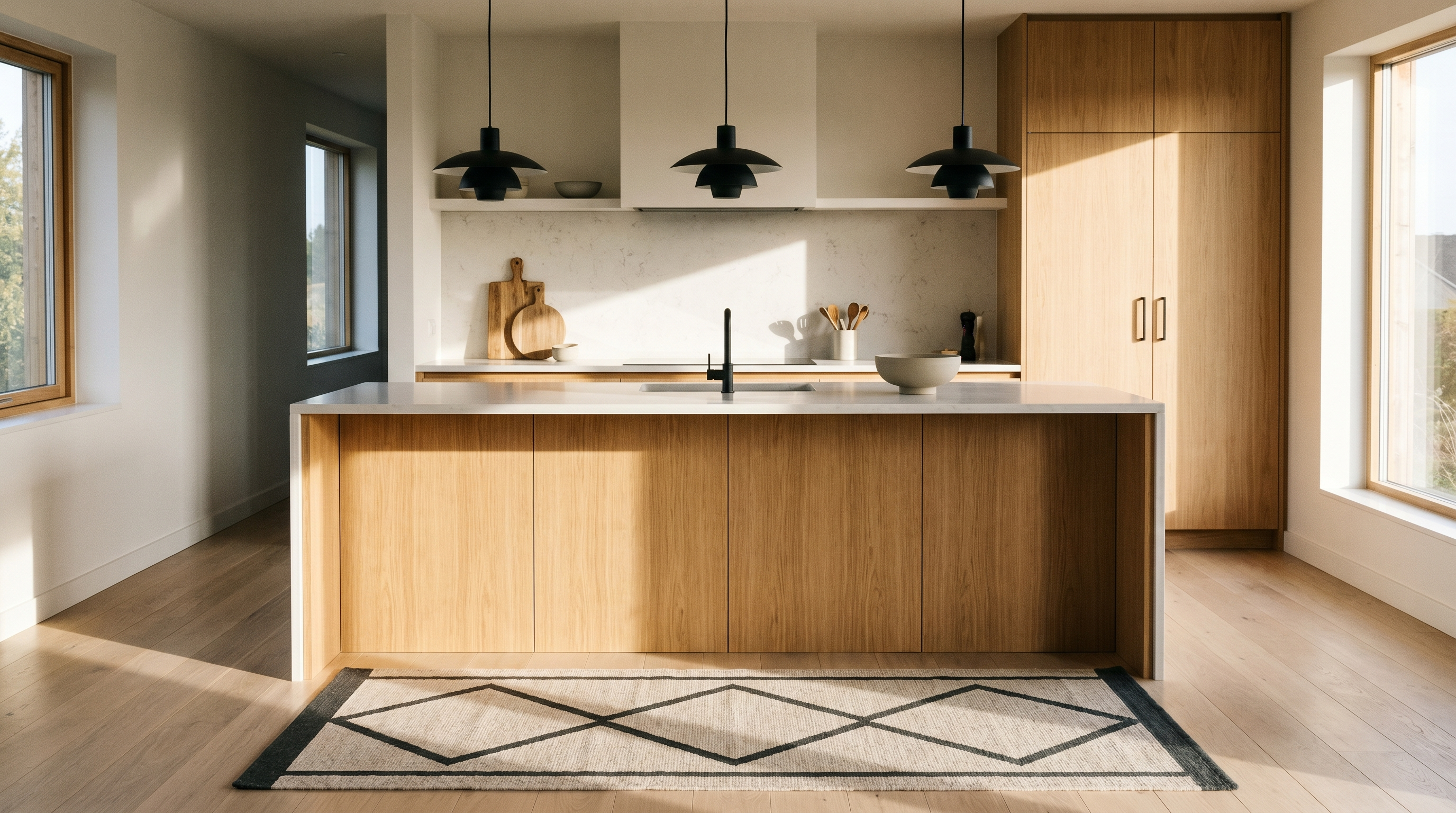
1. Why put a rug in the kitchen?
In most homes, the kitchen has become the liveliest room in the house. We cook there, eat there, talk there, sometimes work there. And yet it is still the room everyone forgets about when it comes to rugs. Too messy, too fragile, too much of a chore to look after: the objections are many. None of them hold in 2026, now that there is a range designed specifically for this room.
A kitchen rug does four concrete jobs. Thermal comfort first: a cold tiled floor in front of the sink means ten minutes of washing up with frozen bare feet. The rug insulates. Joint comfort next: standing for twenty minutes preparing a meal on a hard floor tires the knees and the lower back. A cushioning fibre changes the experience. Safety too: a non-slip backing prevents a slip when the floor is wet, especially in front of a sink or a leaking dishwasher. And finally visual warmth: a long runner in front of a white worktop breaks up the austerity of a modern kitchen and softens the volumes.
2. The critical zones: where to lay the rug
Before choosing a size, you need to work out where the rug will actually be used. Four cases stand out in an average French kitchen.
In front of the sink or the dishwasher. This is the dampest and most static zone. You stand there, you splash, you wipe a dripping plate. A compact 60x100 cm or 80x150 cm is enough. The material absolutely has to be machine washable.
In front of the main worktop. This is the prep zone. Here the rug is exposed to splashes of oil, cooking juices and flour. A well-placed 80x150 cm covers the length of a standard worktop of 1.5 to 1.8 m. For a longer run, move up to a runner.
In front of the island. If the kitchen has one, the island redefines the circulation zone. A long runner of 200 to 280 cm laid parallel to the island structures the space and brings comfort along its whole length.
Galley kitchen. This is the classic case in Paris and Lyon flats. The kitchen is narrow, sometimes 90 to 120 cm wide between the units. A runner 60 to 80 cm wide by 200 to 300 cm long is the obvious answer, chosen from the compatible sizes.
3. The sizes that suit a kitchen
The Casemira catalogue has two families of sizes designed specifically for kitchens. Here is how to choose between them depending on your layout.
| Size | Typical use | Kitchen layout |
|---|---|---|
| 60x100 cm | In front of the sink or dishwasher, at the end of a worktop | Small kitchen, kitchenette, studio flat |
| 80x150 cm | In front of the worktop, in front of a short island | Standard kitchen 8 to 12 m² |
| Runner 60-80 cm x 200 cm | Galley kitchen, in front of a run of units | Narrow kitchen or corridor kitchen |
| Runner 80-90 cm x 250-300 cm | In front of a large island, open-plan kitchen | Kitchen open to the living room, large volume |
For a kitchen open to the living room, there are two schools of thought. The first: treat the kitchen and the living room as two distinct zones, with a kitchen runner plus a large living-room rug. The second: use a single large rug that runs under the island and spills over into the dining corner. That second option is risky if the island gets heavy use, because the rug then takes all the splashes without being able to go in the machine.
4. The materials in the Casemira kitchen range
The Casemira kitchen collection rests on three materials tested for this specific use. No pure wool: contact with damp and grease rules it out. No Easy Clean tag either (which combines four technical badges for indoor living spaces), but a clear spread of classic washable rugs aimed at kitchens.
4.1 Printed washable polyester (Terrazzo, Onyx)
This is the dominant material in the kitchen collection. Digitally printed polyester allows rich, high-definition patterns across the whole colour palette. Machine washable at 30 °C on a delicate programme. Built-in non-slip backing. The Terrazzo (vintage, oriental, geometric and floral patterns) and Onyx (black & gold, navy & gold, contemporary patterns) collections cover most of the kitchen catalogue, in 60x100 and 80x150 cm sizes.
Printed polyester is the right choice for: in front of the sink, in front of the dishwasher, under a high chair, in a kitchenette. It takes regular washing without distorting and returns to its original look once dry.
4.2 Heat-Set frisé polypropylene runners (Mirador, Torino)
For galley kitchens and the zone in front of an island, Heat-Set frisé polypropylene is the benchmark. 100% polypropylene compositions, certified Oeko-Tex Standard 100, a pile height of about 9 to 10 mm, a density of 1900 to 2500 g/m². The Mirador and Torino collections come as runners 60 to 150 cm wide depending on the model, with adjustable length. The feel is close to wool, resistance to repeated footfall is excellent, and they are very easy to look after with a vacuum or dry cleaning.
They are not machine-washable models (too large, and the backing is not suited to it), but they stand up particularly well to splashes thanks to a dense pile that does not hold liquids at the surface.
4.3 BCF polypropylene (Valore, Camden)
A flatter version of polypropylene, with a low pile (9 mm) and a density of 1300 g/m². Made in Turkey. For very busy kitchens where you want a crisp pattern (oriental, geometric) with no relief. Runner format only, from 60 to 150 cm wide depending on the model.
4.4 Washable cotton and polyester blend (Vertigo)
The only model in the kitchen collection that combines a natural and a synthetic fibre: 60 % cotton + 40 % polyester, built-in non-slip backing, washable at 30 °C on a delicate programme, pile height 6 mm. Available in 80x150 cm. A good option if you want a slightly more natural feel than pure polyester while keeping the benefit of machine washing.
“In a kitchen, the right rug is the one that goes in the machine without batting an eyelid.”
5. Colours and patterns: hiding the splashes
Kitchens get dirty. That is simply how it works. The right instinct on colour is to plan for it rather than put up with it. Three simple principles.
First principle: avoid plain colours that are too pale or too dark. A plain cream rug shows the smallest drop of coffee. A plain black rug reveals specks of flour, dust and pet hair. The compromise sits between those two extremes, in mid tones (warm beige, taupe, pearl grey) or in multicoloured palettes that busy the eye before a stain can take over.
Second principle: go for dense patterns. A busy pattern (vintage, modernised tribal, oriental, terrazzo) visually absorbs a splash. The eye does not settle on the mark, it carries on with the pattern. The Terrazzo and Onyx collections work on exactly this principle, with rich palettes, veined effects and calculated contrasts.
Third principle: line up with the splashback and the worktop. If the splashback is veined marble, a rug with gold or charcoal veining carries the language on. If the worktop is pale oak, a rug in warm tones (caramel, terracotta, copper) creates coherence without monotony.
To go further on choosing the overall colour for a room, the complete guide to choosing a rug colour sets out the combinations that work across 13 different decorating styles.
6. Day-to-day care of a kitchen rug
Looking after a kitchen rug happens on three timescales: the immediate reflex on a stain, the weekly clean, and the deep wash every month or two.
The immediate reflex on a stain. A splash of oil, a spot of tomato juice, a drop of wine: blot straight away with kitchen paper, without rubbing. Rubbing spreads the stain and drives it into the fibre. Blot from the edge towards the centre. If the stain holds on, use a little warm water with a drop of washing-up liquid on a clean cloth, blot, rinse with clear water and wipe dry.
The weekly clean. Vacuum in the direction of the pile, two passes at right angles to each other. For a runner in front of a worktop, a vacuum without an electric rotor (soft brush) is plenty and protects the pile.
The deep wash. For the washable polyester models (Terrazzo, Onyx) and the Vertigo cotton/polyester blend: machine wash at 30°C, delicate programme, mild detergent with no bleach, a gentle spin (never a fast spin), dry flat in the open air. Reckon on once a month with heavy use, once every two months with normal use. For the polypropylene runners (Mirador, Torino, Valore, Camden), machine washing is not an option: have them dry cleaned professionally once or twice a year, and otherwise vacuum them and blot stains as soon as they happen.
For a complete guide to caring for washable rugs, the complete washable rug guide sets out every machine setting and best practice.
7. The 5 mistakes to avoid
Mistake 1: choosing a rug that is too thick in front of an oven or a dishwasher. More than 12 mm of pile height means the oven or dishwasher door catches or jams. In these particular spots, stay under 10 mm.
Mistake 2: forgetting the non-slip backing. A kitchen means a floor that will get wet sooner or later. A rug that slides in front of a sink is a fall waiting to happen. Every Terrazzo, Onyx and Vertigo model in the kitchen collection has a non-slip backing built in. For the polypropylene runners, which do not, add a non-slip underlay bought separately.
Mistake 3: putting a non-washable rug in a damp zone. Wool, viscose and pure Tencel are beautiful premium materials. But they cannot go in the machine. In front of a sink, the answer is no.
Mistake 4: undersizing the runner. An 80x200 cm runner in front of a 3 m worktop leaves both ends of the run without a rug. Measure the length of the run and choose a length that matches: for a 2.5 m worktop, aim for a runner of 200 to 250 cm. For 3 m, go for 280 or 300 cm.
Mistake 5: overlooking the thickness at the threshold. If the kitchen opens onto a living room with a threshold strip or a change of flooring, check that the thickness of the rug does not create a dangerous step. Under 10 mm, the transition stays smooth.
Buying a kitchen rug at Casemira
To see the whole selection, the Casemira kitchen rug collection brings together every washable polyester model, polypropylene runner and cotton blend, with filters by size and colour. Free delivery over €100 (€9.99 below that), dispatch within 24 to 48 working hours, free returns within 30 days. Payment by card or PayPal. Casemira customer service answers by email at contact@casemira.com for any question about whether a size will work in your kitchen.
Three Casemira rugs for the kitchen
 Blue & Copper Vintage Kitchen Rug - Terrazzo
 Mauve & Anthracite Vintage Kitchen Rug - Terrazzo No. 2
 Pink & Burgundy Oriental Kitchen Rug - Terrazzo No. 3
Your questions about kitchen rugs
What size rug for a standard kitchen?
Is a kitchen rug really machine washable?
Will my kitchen rug slide about?
Which colour hides stains best?
How often should you wash a kitchen rug?
Can you lay a kitchen rug over underfloor heating?
Written by the Casemira team, based in Brittany. Find out more about Casemira.