7 min read · Updated 4 June 2026
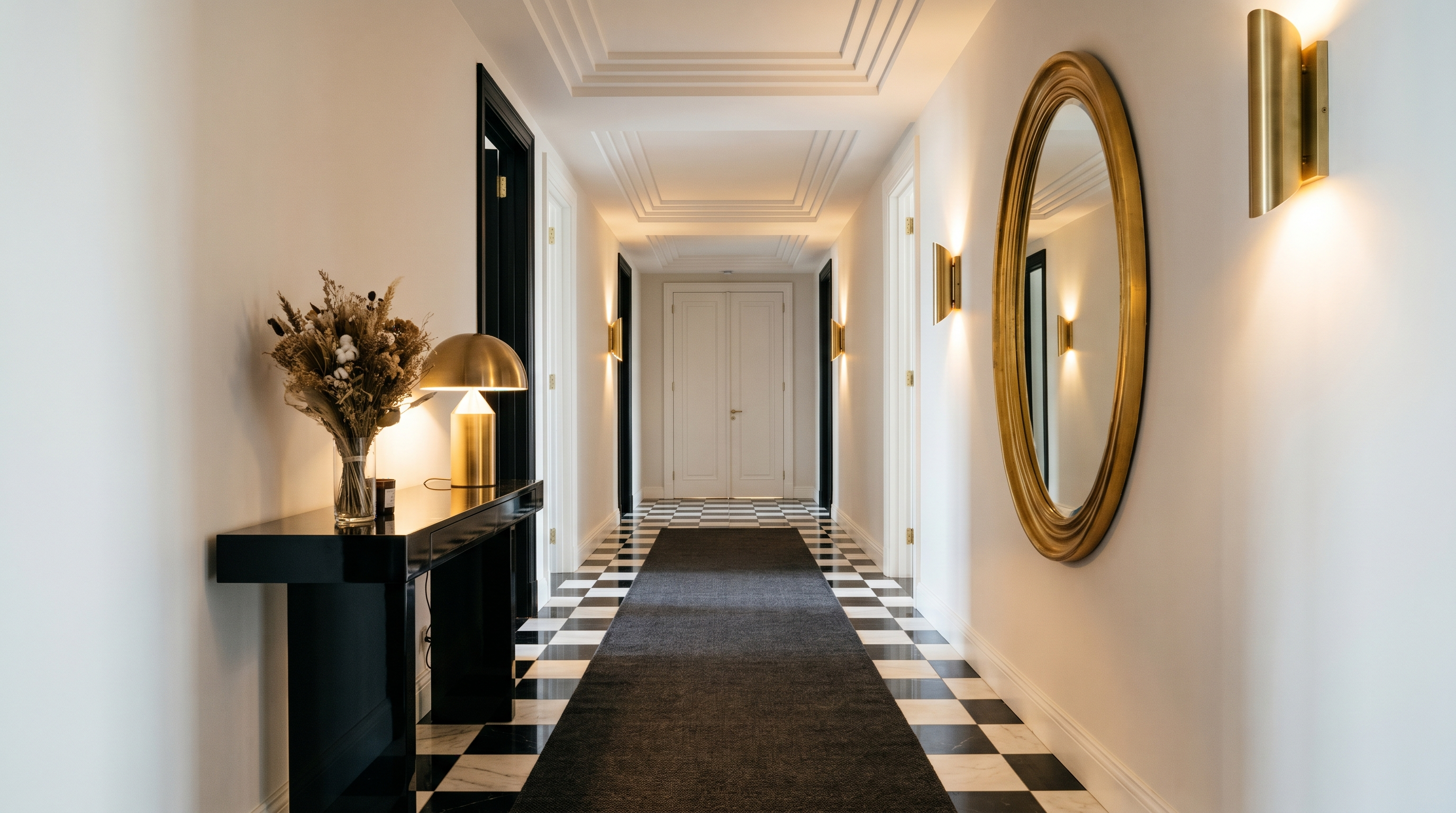
A hallway is the room you walk through, never the one you look at. Which is exactly why a well-dressed hallway makes such a difference: it becomes a space rather than an airlock. And in a hallway, a rug plays a very particular role. More than a decorative object, it is a guiding line that leads the eye, gives the floor structure, and literally changes how long the space feels.
1. The long hallway, an overlooked design challenge
Three reasons explain why hallways are so often left bare:
You pass through quickly. A hallway is not a place to pause. You move between rooms without lingering. That transit logic leads people to under-invest in it, even though it can account for 10 to 15% of the living area of a flat.
The dimensions are awkward. Hallways in period buildings are typically 80 to 100 cm wide and 4 to 8 metres long. No standard shop-bought rug (60×90, 80×150, 120×170) fits those proportions. That means made to measure, which until recently was a specialist service.
The floor takes a beating. As the first place shoes land after coming in from outside, and a route in permanent use, a hallway floor is among the most punished in the home. A rug helps protect it, but it has to be built to cope.
This is precisely where the Casemira made-to-measure runner service comes into its own (52 designs in 100% polypropylene, made to measure in width by length, dispatched in 24 to 48 hours). See how it works in full in our made-to-measure runner and stair runner guide.
2. Why 60 cm is still the reference width
Of the six widths available in the Casemira selector (60, 70, 80, 90, 100 and 120 cm), 60 cm remains the most requested for long hallways. Three reasons:
It fits most period hallways. An 80 cm hallway with a 60 cm runner leaves 10 cm of margin on each side. A 90 cm hallway with a 60 cm runner leaves 15 cm. Those margins are the visual breathing space that stops the rug reading as fitted carpet.
It matches the natural walking line. A human stride is 50 to 55 cm wide. A 60 cm runner captures the whole tread zone without spreading further than it needs to.
It stays manageable and economical. At equal length, 60 cm costs less than 80 or 100 cm, and unrolls more easily. On an 8 m hallway, the price gap between a 60×800 and a 100×800 can reach €100 to €150 depending on the design.
In hallways over 100 cm wide, 70 or 80 cm becomes relevant, and 100 cm for really spacious halls. But for the classic flat hallway, the 1930s block or the town house, 60 cm remains the reference.
3. Working out the margins by length
The longer the hallway, the more the front margin (between the first door and the start of the rug) counts visually. Four typical cases:
| Hallway length | Recommended 60 cm runner length | Front margin | Rear margin |
|---|---|---|---|
| 4 m | 3.50 m | 25 cm | 25 cm |
| 6 m | 5.50 m | 25 cm | 25 cm |
| 8 m | 7.50 m | 25 cm | 25 cm |
| 10 m | 9.00 m, or 2 × 4.50 m joined | 50 cm | 50 cm |
The universal rule: leave at least 25 cm of clear margin before the first door and after the last, so the rug does not touch the threshold. In very long hallways (10 m and over), increase that to 40-50 cm to give the composition room to breathe.
Doors along the way are a special case: if a door opens into the middle of the hallway, check that it can swing freely over the rug. On a standard polypropylene runner 8 to 10 mm thick, most period doors (with a standard gap) open without catching. If in doubt, test it by putting a 1 cm thick book under the door before you buy.
4. Optical effects: shorten, lengthen, balance
The pattern and colour of a runner directly affect how long the hallway feels. Three effects to know:
The "make it longer still" effect: a plain pale runner (sand beige, cream, linen) or one with lengthways motifs (stripes running with the length, gradual ombre patterns) accentuates the perspective. Choose this in a hallway that feels too short and leads to a good view.
The "visually shorten it" effect: a runner with crossways motifs (bands across the width, motifs repeated at regular intervals, medallions in sequence) interrupts the eye and breaks up the sense of length. Choose this in a very long hallway that feels endless.
The "steady balance" effect: a bordered design (a 3-5 cm outer frame with a plain central field) or a regular geometric motif (squares, diamonds) gives the hallway a clear presence without making it feel longer or shorter. A safe choice in 80% of settings.
"A long hallway is a stage. The rug writes its opening line."
5. Patterns and colours by setting
Four hallway profiles, four families of rug:
A light, bright hallway with pale wooden floors. Go for soft tones (sand beige, linen, ivory) in a plain or discreetly patterned design. Designs worth a look: the plain Ravello, Mirador in beige and grey, or a faded vintage. See also our beige rug guide.
A dark hallway with little natural light and dark floors. Here the rug compensates. Choose pale tones or warm saturated shades (terracotta, ochre, golden yellow) that bounce artificial light around. Avoid charcoals and burgundies, which darken it further.
A hallway in a period apartment building. The setting calls for an elegant classic runner: contemporary Persian motifs (Valore, Riviera), medallions in sequence, a traditional palette of deep burgundy, indigo blue and ivory. See our oriental rug guide to explore that look.
An industrial loft or contemporary house. Go for a graphic geometric runner (Mirador, Arcano), a plain charcoal or cream, or the Camden with its updated oriental motifs. A controlled contrast between an industrial floor and the textile.
On colour more broadly, our guide to choosing a rug colour goes deeper into the 60-30-10 rule and warm versus cool undertones.
6. Continuity or contrast between rooms
A question that comes up again and again: should the hallway runner stop before the doors, or carry on with another rug in the adjoining room?
The continuity approach: the same style (same palette, same kind of motif) on the hallway runner and on the living room or bedroom rug. The eye reads it as one coherent whole, which works particularly well in period flats and classic houses.
The contrast approach: complementary but distinct styles. A geometric motif in the hallway, a handmade wool piece in the living room. This asserts the different functions of the two spaces, and reads as more contemporary.
The hybrid approach: the same dominant colour, different motifs. Hallway and living room share a sand beige or a charcoal, but the hallway is plain and the living room patterned (or the other way round). A compromise that works in most schemes.
For rooms of 15 to 20 m² at the end of the hallway, 160×230 remains the pivotal size (see our 160×230 rug guide). For 20 to 25 m², step up to 200×300 (see our 200×300 rug guide).
7. Laying, grip and multiple joins
Laying a single runner (up to 10 m). Unroll from the far end of the hallway towards the entrance, aiming to centre it as you go. Casemira polypropylene arrives tightly rolled, so allow 24 to 48 hours for it to settle flat naturally. Once in place, adjust the margins with small nudges of the foot.
Grip. Every Casemira runner has a built-in latex backing that holds on most hard floors (wood, tiles, vinyl). On very smooth surfaces (polished tiles, varnished lino), a thin additional non-slip underlay reinforces the grip.
Multiple joins (hallways over 10 m). For a 12 m hallway, for instance, there are two options:
- Combine an 8 m and a 4 m of the same design, joining them at an intermediate doorway threshold
- Combine two 6 m lengths, joined halfway along the hallway
The join is simply a butt joint. A double-sided textile tape (from any hardware shop) can reinforce it if the area is very busy. To the eye, a clean join under a threshold or at a change of room stays invisible.
Beyond 10 m in a single piece, or for dimensions outside the grid, write to contact@casemira.com. The team looks at every request and replies within 24 to 48 working hours with a feasibility study. Customer service is also available on 02 59 66 01 35 (Monday to Saturday, 8am to 8pm).
Three Casemira runners for the hallway
 Plain Blue Runner - Ravello
 Modern Grey & Charcoal Runner - Camden
 Plain Green Runner - Dante
8. FAQ: long hallway runners
Your questions about long hallway runners
What is the ideal width for a 90 cm hallway?
60 cm or 70 cm. The 60 leaves 15 cm of margin on each side (an airy look), the 70 leaves 10 cm on each side (a more present one). Above 100 cm of hallway, move up to 80 or 90 cm.
How do I work out the exact length?
Measure the usable length (between the first and last doors). Subtract 50 cm for the margins (25 cm at the front, 25 cm at the back). Then choose the next length down, or equal, in the Casemira selector (10 cm steps up to 5 m, 50 cm beyond).
Does the pattern affect how long the hallway feels?
Yes, strongly. A lengthways motif (stripes, ombre effects) accentuates the perspective and makes the hallway feel longer. A crossways motif (bands, medallions in sequence) interrupts the eye and visually shortens it. Choose according to what you want.
Do I need a non-slip underlay?
Not in most cases. Every Casemira runner has a built-in latex backing that holds on wood, tiles and vinyl. An additional underlay is only useful on very smooth floors (polished tiles, varnished lino).
What about a 12 metre hallway?
Two options: combine an 8 m and a 4 m (or two 6 m lengths) of the same design, joined at an intermediate threshold; OR write to contact@casemira.com so we can look at a bespoke request outside the standard grid (answered within 24 to 48 working hours).
How much does a long hallway runner cost?
Prices run from €33 to €453 depending on the design and the dimensions you choose in the selector. For a 60 cm by 6 m in a mid-range design, budget €200 to €280. For an 80 cm by 8 m in a premium design, €350 to €420. Each product page is the reference.
Written by the Casemira team, based in Brittany. More about Casemira.