7 min read · Updated 29 May 2026
The oriental rug carries a thousand years of history: trade routes, symbols, coded motifs and craft handed down through generations. It also has a very different contemporary reality, because most oriental rugs on the market today are machine woven in modern textile mills using high-performance technical fibres. That double identity, inherited and modernised at once, explains why the oriental rug remains one of the best-selling families in Europe, alongside Scandinavian and contemporary Berber designs.
1. The oriental rug today
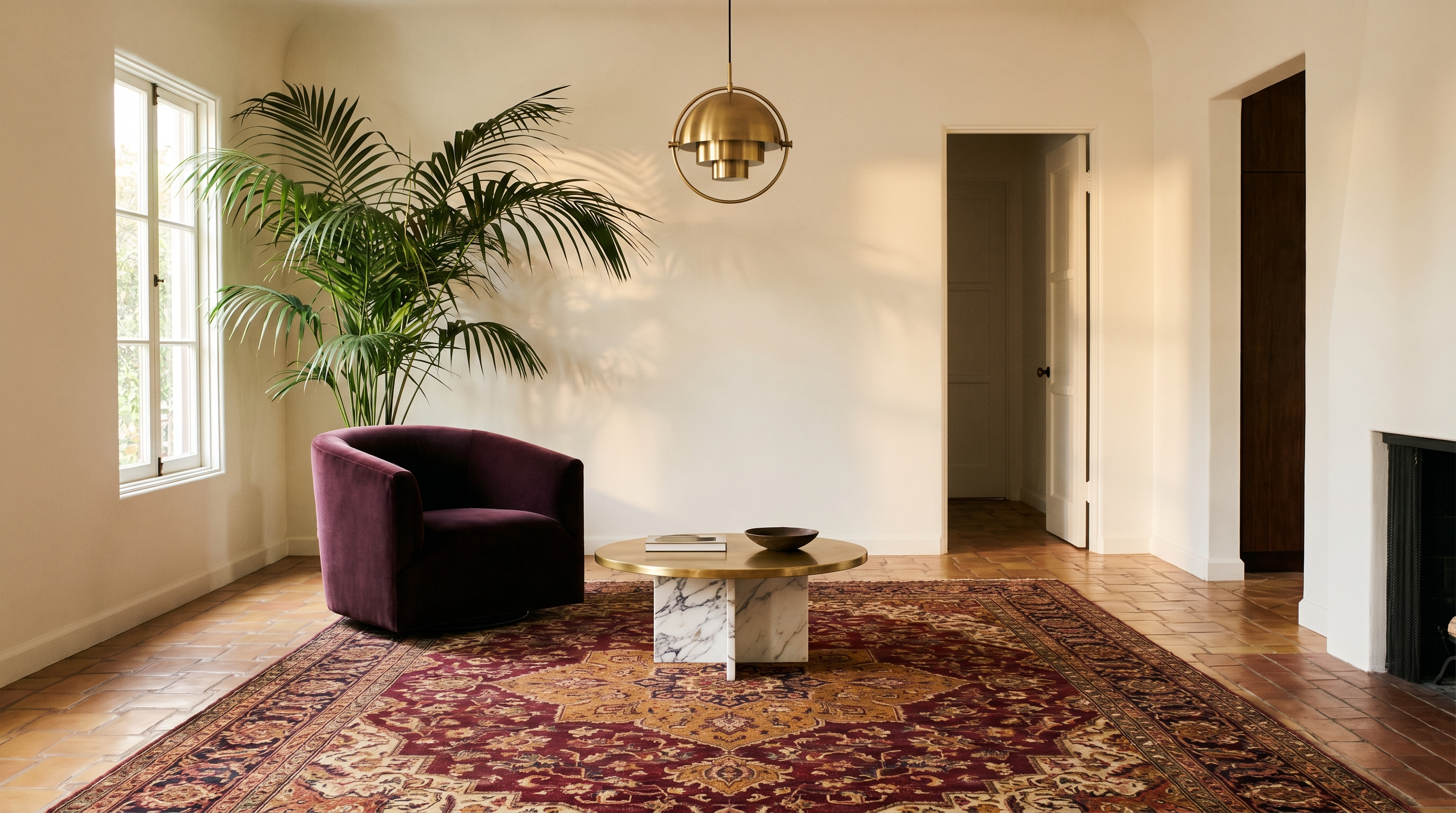
The word "oriental" actually covers several traditions, chiefly Persian (Iran), Turkish (Anatolia), Caucasian and Asian. Each has its own motifs, palettes and techniques. But in 2026, on most interiors websites, "oriental" describes above all a style: central medallions, elaborate borders, palmettes, arabesques and a traditional palette of deep red, indigo blue, ochre and ivory. The rug on sale is not necessarily hand-knotted. It may be machine woven, in modern fibres, and still reach a very high level of pattern definition and weave density.
Casemira works within that contemporary logic. The 49 designs in the oriental rug collection are machine woven in BCF or heat-set polypropylene, made in Turkey, with an average density of 1,300 g/m² on the standard designs. The 34 designs in the higher-end Persian rug collection come in two constructions:
- 100% Modal Silk: 14 designs in a silk-effect acrylic fibre of extraordinary softness, weave density up to 3,000,000 knots per square metre, 5 mm pile, made in Turkey. Supplied with a certificate of authenticity and decorative fringing.
- 100% Acrylic-Cotton Basic: 20 designs in an acrylic and cotton blend, classic Persian palette, at a more accessible price.
That transparency matters: Casemira sells the oriental style, not antique hand-knotted rugs. This positioning makes Persian aesthetics and traditional motifs available on a contained budget (under €600 for some very handsome pieces), in fibres that are robust, easy to look after and long-lasting.
2. Traditional patterns explained
Four motifs structure the vast majority of contemporary oriental rugs:
The central medallion. A large oval or polygonal shape at the centre of the rug, usually richly worked with floral arabesques. It is the most widespread composition and suits rectangular living rooms particularly well, where the medallion becomes the visual focal point.
The herati border. Also known as the "little fish" pattern, it is built from stylised floral motifs in successive bands framing the rug. A good herati border has at least three bands (a fine outer one, a wide main one, a fine inner one) that guide the eye and create depth.
Palmettes and arabesques. Recurring floral motifs, sometimes geometricised, that fill the central field between medallion and border. The denser the palmettes, the richer and more intricate the rug looks.
Boteh (or paisley). A teardrop or stylised cypress shape from Persia that inspired the famous Western paisley. It is often repeated in a staggered pattern across the whole field.
Rarer in contemporary interpretations, the garden panel divides the rug into symbolic compartments, echoing the paradise gardens of Persian tradition. That construction is now confined to the very highest-end pieces.
"The oriental motif is a language. Learning to read it is how you enter the rug."
3. Persian rugs at Casemira (the top end)
The Persian rug collection brings together 34 designs priced from €599 to €5,194 (median €1,029). These are the most exclusive pieces in the range, in two distinct technical families:
The Samara range in Modal Silk sits at the very top. The silk-effect acrylic fibre delivers the pearly finish, the softness and the characteristic sheen of natural silk without its fragility or its cost. A weave density of 3,000,000 knots per square metre allows a fineness of pattern rarely reached by machine production, with gradations and details that once only antique hand-knotted rugs could match.
Every Samara piece comes with a certificate of authenticity and decorative fringing, mainly in 160×230 and 200×300 cm. Ideal for an exclusive living room, a guest suite or a prestige office where the rug becomes the centrepiece.
The Acrylic-Cotton Basic range offers 20 more accessible designs in an acrylic and cotton blend, with the same traditional Persian motifs (medallions, herati borders, arabesques) in a classic palette. The fibre is softer than polypropylene, weave density stays high and the result is very convincing for anyone who wants Persian aesthetics without moving up to Modal Silk.
For these pieces, Casemira offers samples at €10 across the 127 eligible designs (Handmade and Easy Clean), deducted in full from your order. For Persian designs not eligible for samples, free returns within 30 days make buying at a distance risk-free.
4. Contemporary oriental style (accessible)
The oriental rug collection offers 49 designs priced from €34 to €454 (median €154). This is the entry and mid-range segment, and it makes real sense for anyone who wants the oriental look without spending €1,000 or more.
Technical construction: 100% BCF or heat-set polypropylene, made in Turkey, 9 mm pile, 1,300 g/m² density. BCF (bulk continuous filament) fibre is engineered for abrasion resistance and long-term colour retention. Naturally stain-resistant, and robot-vacuum friendly on most designs.
Signature designs:
- Valore: medallion and full border motifs in several colourways (red and beige, beige and brown, green and beige, black and silver). Highly versatile and a perfect first oriental rug.
- Camden: a more contemporary palette with updated oriental motifs, ideal for a mid-century living room or an industrial loft.
- Riviera: classic Persian motifs in a machine-woven reading, in a traditional palette of red, burgundy and deep green.
- Terrazzo: an oriental-inspired washable line, part of the washable collection (machine washable at 30 °C).
If you are torn between contemporary oriental and updated Berber style, our Berber style rug guide compares the two families. The main difference: Berber works the weave and repeated geometric motifs, while oriental works symmetrical compositions built around a medallion and a structured border.
5. Traditional colours in a modern room
The traditional oriental palette is built around four dominant shades:
| Colour | Character | What to pair it with |
|---|---|---|
| Deep burgundy red | Warm, sophisticated, the Persian signature | Dark walnut, cognac leather, veined marble |
| Indigo blue | Deep, enigmatic, peaceful | Off-white walls, pale oak, brushed brass |
| Ochre and sand beige | Luminous, Mediterranean | Terracotta tiles, old floorboards, plum or forest green velvet |
| Ivory and ecru | Calm, elegant, timeless | Limestone, white marble, pared-back furniture |
A good contemporary instinct: a deep burgundy oriental rug works better in a minimalist modern living room than the same rug in a space already busy with patterns and colours. The rug becomes the signature piece and everything else stays quiet.
To go further on colour coordination, our guide to choosing a rug colour sets out the 60-30-10 rule and complementary undertones.
6. Which size to choose
The classic oriental rug favours standard rectangular sizes. Four typical cases:
A 15 to 20 m² living room: a 160×230 cm shows off the central medallion without overwhelming the space. It is the best-selling size in the Casemira oriental collection.
A 20 to 25 m² living room: a 200×300 cm is the reference choice. The pattern can breathe, the composition unfolds properly, and the sofa can sit partly on the rug in line with the 20 cm rule.
Hallway or corridor: 80×150 cm or a made-to-measure runner both work, though a central medallion composition is less well served on a narrow format. Designs with repeated motifs (paisley, arabesques) suit this setting better. See our made-to-measure runner guide.
Bedroom: a 160×230 or 200×300 placed at the foot of the bed brings warmth and character. Oriental rugs work particularly well in bedrooms with plain walls, as covered in our bedroom rug guide.
For a full breakdown of sizes room by room, our rug size guide covers every configuration.
7. Care and good habits
The contemporary polypropylene oriental rug is one of the most forgiving in daily use:
Vacuum weekly in the direction of the pile, on moderate power. On BCF designs, vacuuming covers 90% of the upkeep.
Rotate every 6 months to even out wear between the walkway and the sofa zone.
Fresh spills: blot without rubbing, using a clean white cloth, lukewarm water and a little diluted mild soap if needed. Non-porous polypropylene does not soak things up the way wool does.
No machine washing on most classic oriental designs (the Terrazzo washables, explicitly labelled as such, are the exception). For a deep clean, use a specialist rug cleaner every 2 to 3 years.
Moth protection: polypropylene fibre does not attract moths the way wool does, so a contemporary oriental rug stays stable over time with no special precautions.
For Persian pieces in Modal Silk, the protocol is more delicate. Vacuum gently in the direction of the pile, with no rotating brush. Use no wet product without testing first. For a serious stain, call in a professional rug cleaner who handles fine pieces (budget €12 to €20 per m²). Our full rug cleaning guide sets out the protocols material by material.
Three Casemira rugs for the living room
 Oriental Terracotta & Beige Rug - Perugia
 Oriental Blue & Multicoloured Rug - Toscane
 Red Persian Rug - Isfahan
8. FAQ: oriental rugs
Your questions about oriental rugs
Are Casemira oriental rugs hand-knotted?
No. Casemira sells contemporary oriental style rugs, machine woven in Turkey in modern fibres (BCF or heat-set polypropylene for the oriental collection, silk-effect acrylic Modal Silk or Acrylic-Cotton Basic for the Persian collection). That transparency matters: the oriental aesthetic is respected, but production is industrial, which is what keeps prices accessible.
What is the difference between an oriental rug and a Persian rug?
Strictly speaking, a Persian rug is one that comes from Iran. "Oriental" is a broader term covering Iran, Turkey, the Caucasus and Asia. At Casemira, the Persian collection gathers the high-end designs (Modal Silk and Acrylic-Cotton, €599 to €5,194), while the oriental collection offers the accessible polypropylene look (€34 to €454).
How much does a good oriental rug cost?
It depends on the segment. For quality contemporary oriental style, budget €150 to €300 in 160×230 and €250 to €450 in 200×300. For a high-end Persian in Modal Silk, budget €800 to €1,600 in 160×230 depending on the design. Above €3,000 you are into the most exclusive large-format pieces. Each product page is the reference.
Can an oriental rug work in a modern living room?
Yes, and it is one of the most effective pairings in contemporary interiors. Its rich pattern turns the oriental rug into the signature piece of the room, with everything else kept quiet (pared-back furniture, plain walls, a restricted palette). The result is a conversation between tradition and modernity that really works.
How do you check the quality of an oriental rug?
Three criteria matter most: weave density (g/m²), which drives how rich the pattern looks, the material (Modal Silk at the very top, BCF polypropylene for durability, Acrylic-Cotton for softness) and the edge finish (even fringing, clean overlocking). Our guide to spotting a quality rug sets out the full method.
Will an oriental rug suit my pale oak floor?
Very well. Pale oak pairs particularly happily with oriental rugs led by indigo blue, ivory and ecru or light ochre. Avoid heavily saturated reds on a red-toned pale oak floor, as the effect gets too warm. For a full colour pairing guide, see choosing a rug colour.
Written by the Casemira team, based in Brittany. More about Casemira.