7 min read · Updated 13 July 2026
The blue rug is a paradoxical classic: everyone knows what one is, and yet two blues can have nothing in common in the same room. The navy of a sailor's blazer, the teal of a wild duck's wing, the indigo of raw denim, the slate of an old roof: these shades open onto very different interiors. Here is how to read the blue family so you choose the rug that will really talk to your living room or bedroom.
1. The blue family: 4 undertones
The word "blue" covers a very wide chromatic range. To choose a rug, you first have to place the precise shade. Four families shape what is on offer:
Navy. Very dark, deep, almost black in poor light. Chromatic reference: a naval uniform, a midnight blue suit. It brings depth and calm and works with almost any interior (pale or dark, classic or modern). This is the universal living room blue.
Teal. A muted blue-green, neither properly blue nor properly green. Chromatic reference: the plumage of a male mallard. More original and more full of personality than navy. It needs a controlled setting (neutral furniture or pale wood) if it is not to overwhelm.
Indigo. A deep, saturated blue, sharper than navy and denser than slate. Chromatic reference: raw denim, blue Indian ink. It brings graphic character. Excellent in open contemporary spaces.
Slate (grey-blue). A heavily desaturated blue leaning towards grey. Chromatic reference: a slate roof on an overcast day. It is almost a neutral, bringing coolness without committing the room's palette.
Where Casemira stands: the blue rug collection gathers 61 designs covering those four undertones, with navy and deep blues dominating (compatible with most interiors). See also our guide to choosing a rug colour.
2. Navy: calm depth
Navy is the most versatile blue in interior textiles, for three reasons:
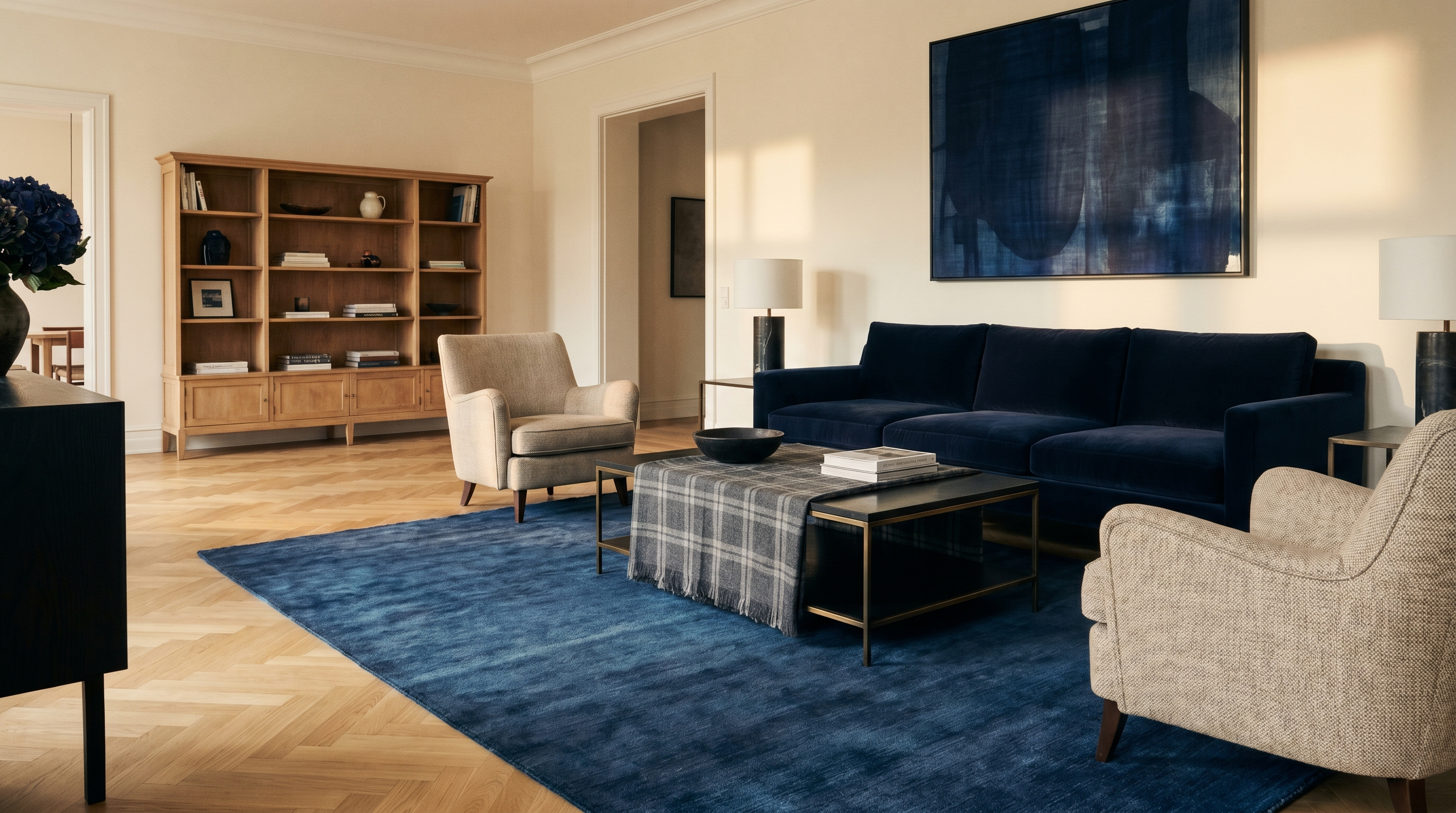
It is almost a neutral. To the eye, a very dark navy behaves like a nuanced black. It sits happily with neutrals (beige, white, grey, taupe), with timbers (pale oak, walnut, beech) and with other deep tones (burgundy, forest green, plum).
It visually enlarges a room. Deep blue appears to recede in perspective. A navy rug on the floor creates a sense of depth, which is particularly useful in small living rooms that need help.
It ages well. Unlike bright shades, navy stays readable over time. A passing fashion will not date it in two seasons.
Ideal room profiles for navy:
- A classic living room with pale oak floors: navy lays down a restrained base that lifts the whole scheme
- A main bedroom with white walls: navy brings calm and depth, perfect for sleep
- A home office: navy concentrates the eye and gives the room structure
- A small living room (15-18 m²): navy pushes the boundaries back visually
At Casemira, most of the 61 blue designs are navies or deep blues, in polyester (25 designs) or polypropylene (18 designs). See also our grey rug guide for interiors torn between deep blue and dark grey.
3. Teal: muted elegance
Teal has come back strongly since 2020. It is a desaturated blue leaning towards green, whose depth depends heavily on the light in the room.
Three visual markers of teal:
Medium saturation. Neither dull nor vivid. Teal is immediately distinguishable from navy (darker) and from turquoise (brighter and paler).
A subtle green cast. Under warm light, teal leans green. Under cool light, it leans blue. That variability is its charm, but it means you need to check how it reads in your own daylight.
A sense of material. Teal evokes velvet, feathers, lacquer. It calls for materials that extend that sensation: wool, velvet, lustrous viscose.
Combinations that work with teal:
- Teal with ecru and antiqued brass: understated contemporary elegance
- Teal with pale wood and linen: a warmed-up Scandinavian mood
- Teal with black and white: strong modern graphics
- Teal with terracotta and dark wood: a warm autumnal contrast
For a subtle teal in a living space, go for 160×230 or 200×290 cm, laid under the sofa. Teal works best in a defined zone rather than as wall-to-wall cover.
"Blue is the only deep neutral that stays alive."
4. Indigo and slate: graphic density
Indigo is a saturated, deep blue, close to raw denim. It has three characteristics:
High visual density. Indigo holds a room the way a soft black does. It lays down a strongly defined zone on the floor.
Stylistic versatility. Indigo lends itself to modern schemes (strong graphic motifs, clean lines), to classic ones (Persian motifs or contemporary kilims) and to minimalism (plain). It is a blue that does not belong to a single vocabulary.
Material compatibility. Indigo looks particularly good on lustrous viscose (the shades shift with the light), on matt wool (unapologetic visual density) and on polyester (a clean graphic result).
Slate (grey-blue) sits at the other end of the blue family. Heavily desaturated, almost grey, it behaves like a cool neutral.
Three typical uses for slate:
- A Scandinavian living room: slate calms the whole scheme and brings coolness without committing to much
- A very bright room: natural light wakes slate up into a soft blue
- A masculine interior: slate suits dark furniture and raw materials (linen, leather, wood)
The 4 undertones compared:
| Undertone | Depth | Personality | Compatibility |
|---|---|---|---|
| Navy | Very deep | Universal calm | Any interior |
| Teal | Medium to deep | Muted elegance | Controlled schemes |
| Indigo | Deep and saturated | Strongly graphic | Modern and mixed |
| Slate | Desaturated and light | Cool neutral | Scandinavian, bright rooms |
5. 61 Casemira blue rug designs
The blue rug collection gathers 61 designs across four price and material profiles.
| Profile | Main materials | Price | Ideal use |
|---|---|---|---|
| Accessible family living room | Polyester, polypropylene | €34-249 | Living rooms with children, regular traffic |
| Decorative washable cotton | Cotton (16 designs) | €49-189 | Bedrooms, bright rooms |
| Refined living room | Viscose (4 designs) | €349-1,199 | Elegant living rooms, light traffic |
| Top of the range | Silk (4 designs), wool | €1,200-5,194 | Reception rooms, little traffic |
Materials across the 61 designs: polyester 25, polypropylene 18, cotton 16, silk 4, viscose 4, wool 1. Shapes: 59 rectangles plus 2 rounds. Non-slip: 34 designs come with a built-in non-slip layer for immediate stability.
Casemira guarantees on the blue collection:
- Free delivery from €100 (€9.99 below that), dispatched within 24 to 48 hours from our warehouses.
- Free returns within 30 days, no conditions, which is essential for confirming the shade (blues vary a great deal with the light).
- Klarna in 3 interest-free instalments, no minimum, available from the basket.
- Samples at €10 each (20×30 cm) across 127 eligible designs (the handmade collection plus the Easy Clean washables), deducted in full when you buy. Particularly useful in blue, where the shades can surprise you. See rug samples.
6. How to work a blue rug into a room
Six principles for placing a blue rug:
Check the shade in natural light. This is the golden rule for blue: the same rug can look navy under warm lighting and shift towards petrol under cool lighting. Ordering a 20×30 cm sample is particularly worthwhile here.
Limit how much blue there is in the room. If the walls are already blue, or the sofa is blue, a blue rug can tip it over. The balancing rule: one major blue element per room, everything else in neutrals or complementary tones.
Pair blue with warm tones. Blue can feel a little cold across a large area. Pairing it with pale wood, antiqued brass, a terracotta cushion or ecru curtains takes the edge off.
Choose the size to suit the layout. In a living room, 160×230 or 200×290 cm depending on the size of the space. In a bedroom, 200×290 or 240×340 cm at the foot of the bed or underneath it. See our living room rug size guide.
Think about grip. 34 of the 61 Casemira blue designs come with a built-in non-slip layer. For the others, a universal non-slip underlay settles the question.
Think about how it combines with other colours. A deep blue rug can talk very happily to a terracotta rug in the next room, or a beige one in the hallway. See our terracotta rug and beige rug guides.
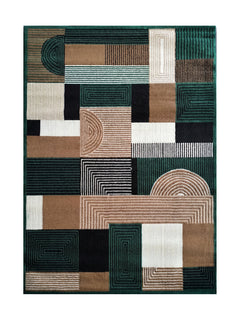
Three Casemira rugs for the living room
 Washable Charcoal & Blue Design Rug - Terrazzo
 Geometric Blue & Cream Rug - Capri No. 04
 100% Wool Rug - Venere Pastel
7. FAQ: blue rugs
Which shade of blue is the most versatile?
Navy. Very dark and edging towards a nuanced black, it works as a deep neutral and sits happily with almost any interior (classic, modern, Scandinavian). Teal carries more personality, indigo is more graphic, slate more discreet. If you are unsure, start with navy.
Can a blue rug make a small living room look bigger?
Yes, particularly in navy or indigo. Deep blues appear to recede in perspective and create a sense of depth, which visually opens up a small space. Provided you do not surround it with other dark elements (furniture, curtains) that would cancel the effect.
Does a blue rug get dirty faster than a beige one?
No. In terms of how visible the dirt is, a deep blue is actually more forgiving than a pale beige: dust, crumbs and dry footmarks show less on a navy or indigo ground. For a child's bedroom or a dining area, a deep blue is an excellent practical choice as well as an attractive one.
How do I pair a blue rug with a grey sofa?
A grey sofa with a navy rug is a very successful pairing, particularly with a pale or mid grey (pearl grey, smoke grey). The blue brings depth, the grey brings modernity. Add a terracotta or mustard cushion to warm it up if needed, and go for a pale or mid-dark wooden floor.
Teal or indigo for a main bedroom?
It depends on the mood you want for sleeping. Teal (muted, soft) encourages a calm, enveloping atmosphere. Indigo (saturated, deep) creates a more enveloping, graphic cocoon. Both suit a bedroom, as long as the walls and furniture stay mostly pale or neutral so the room does not become overloaded.
How can I check the shade before deciding?
On eligible designs (the handmade collection and the Easy Clean washables), Casemira offers 20×30 cm samples at €10 each, deducted in full when you buy. For the others, returns are free within 30 days with no conditions: you can take delivery of the rug, unroll it at home in natural light, and send it back if it is not right. Customer service Monday to Saturday, 8am to 8pm on 02 59 66 01 35 or contact@casemira.com.
Written by the Casemira team, based in Brittany.