7 min read · Updated 16 June 2026
The kitchen is the room that throws the most at a textile: splashes of oil, wine knocked over mid-preparation, sauces that spit, crumbs that work their way in, vinegar marks, baked-on grease. For a long time, the advice was to keep textile rugs out of the kitchen for exactly those reasons. Today, materials and treatments have changed the picture: a well-chosen rug copes with daily life without demanding constant vigilance.
1. What makes the kitchen different
Three categories of stain dominate in a kitchen:
Greasy substances (oil, butter, rich sauces, spitting fat). These are the hardest to lift from a porous fibre, but relatively straightforward on a non-absorbent synthetic one.
Coloured liquids (wine, tomato sauce, coffee, fruit juice). There is a risk of a lasting stain if the liquid soaks into the fibre. Acting quickly is essential.
Dry marks (crumbs, powders, flour, salt, sugar). Easy to vacuum up, but they work their way deep into the fibres if you wait.
So a kitchen rug has to combine three properties: a non-porous fibre (to limit soaking), machine washability (for periodic cleaning) and a non-slip backing (safety in a room where people move quickly).
For the wider picture of the kitchen collection (sizes, full care advice, the runner in front of the sink), see our guide to kitchen rugs.
2. Materials and how they handle stains
| Material | Against grease | Against coloured liquids | Machine washable | Ideal kitchen profile |
|---|---|---|---|---|
| Polyester | Good | Good | Yes (30 °C) | Family kitchen, soft vintage motifs |
| BCF polypropylene | Excellent (non-porous) | Excellent | Yes (depending on the design) | Busy kitchen, runner in front of the sink |
| Cotton | Medium (absorbent fibre) | Medium | Yes (30 °C) | Warm bistro kitchen, rustic feel |
Why BCF polypropylene excels in the kitchen: the fibre is non-porous, so liquids do not soak deep into it and stay on the surface where they can be mopped up quickly. It is the opposite of wool or cotton, which absorb like a sponge.
Why polyester is the most common material at Casemira: it combines sufficient stain resistance with a softer feel than polypropylene, while staying machine washable. It is the ideal balance for most family kitchens.
Why cotton stays in the minority (3 designs out of 96): it is more absorbent and calls for greater vigilance. Worth choosing for bistro kitchens where atmosphere matters more than maximum durability.
Important: the kitchen is not where the Easy Clean designs belong (they are made for the living room and indoor living spaces, with their four combined treatments). In the kitchen, the 96 dedicated designs come with their own routines for an environment of damp, grease and splashes.
3. The Casemira kitchen catalogue
96 designs in the kitchen rug collection, structured like this:
| Feature | Detail |
|---|---|
| Designs in total | 96 |
| Materials | Polyester (64), polypropylene (32), cotton (3) |
| Shapes | Rectangle (64), runner (32) |
| Non-slip | 64 designs tagged propriete:Antidérapant |
| Machine washable | 64 designs tagged propriete:Lavable |
| Price range | €33 to €349, median €118 |
| Certification | 18 Oeko-Tex designs (out of the 96) |
An important note on vinyl: the vinyl kitchen mat (a recurring cliché) is not part of the Casemira catalogue. That is a deliberate position: a well-chosen textile (BCF polypropylene, washable polyester) offers the same practical durability with a warmer feel, better acoustic comfort and a genuine decorative presence that vinyl cannot match. See also Easy Clean rugs for the textile versus vinyl comparison.
"A good kitchen rug does not run from a stain. It waits for it calmly."
4. The runner in front of the sink
Of the 96 designs, 32 come as runners (long and narrow, typically 60-80 cm wide by 180-240 cm long). That shape is calibrated for the most exposed part of the kitchen:
In front of the sink. A zone of constant splashing while rinsing vegetables, washing up or filling jugs. The runner protects the floor and adds comfort while you stand.
In front of the worktop. The preparation zone, where you stand for anything from 30 minutes to 2 hours. The runner cushions all that standing.
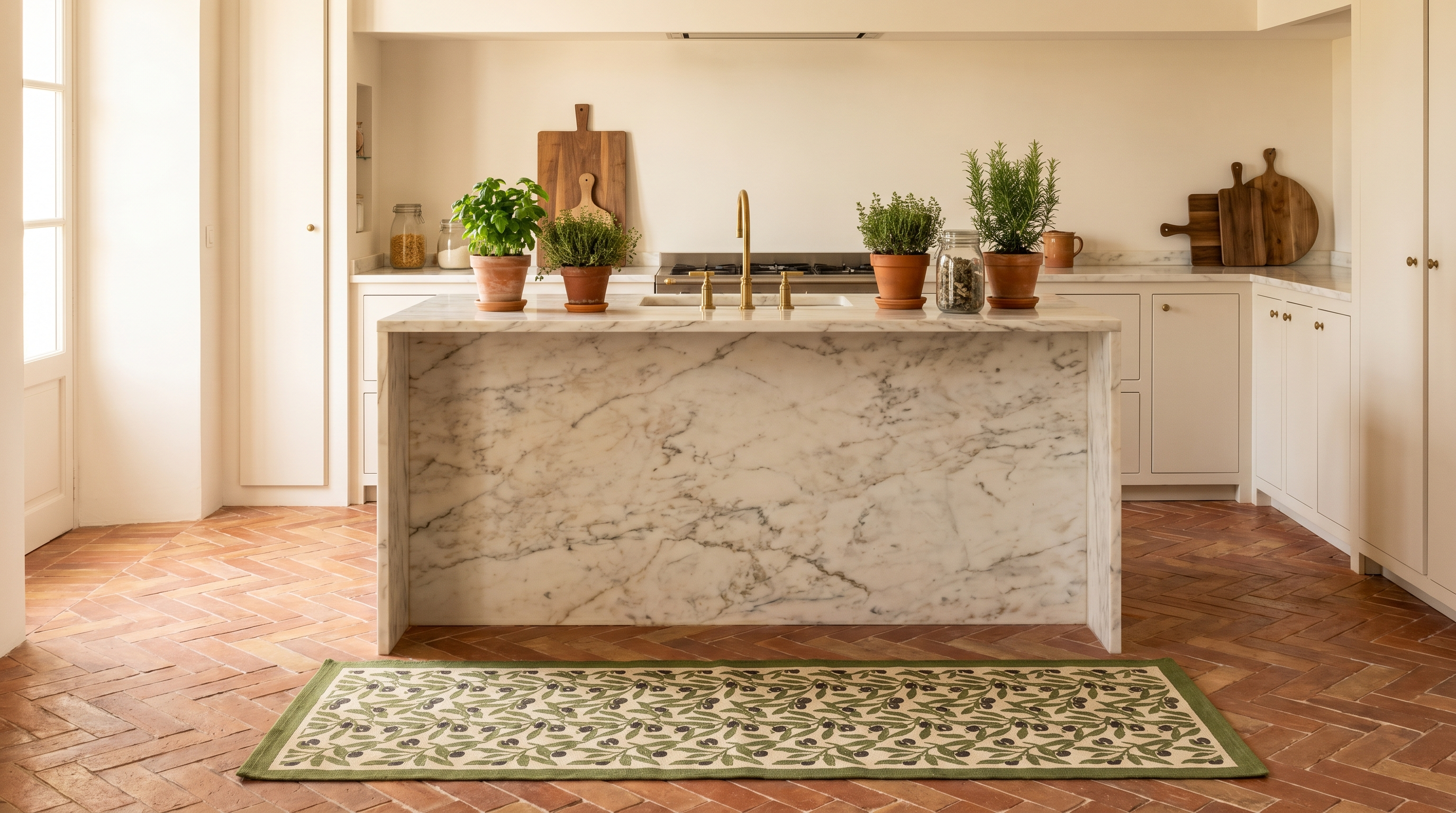
Along a kitchen island. In kitchens with an island, a 240 cm × 80 cm runner shapes the circulation while dressing the floor.
For smaller kitchens or specific spots (in front of the oven, under the table), a rectangular 80×150 or 120×170 works better.
The Casemira made-to-measure runner service, meanwhile, belongs to the runner rug collection (52 designs in 100% polypropylene). For the kitchen, stick to the kitchen-specific designs in the dedicated collection. See made-to-measure runners and stair runners.
5. Stain routines for the kitchen
Five typical kitchen cases:
1. Olive oil or melted butter. Sprinkle fuller's earth over it straight away (an absorbent mineral powder, from any hardware shop). Leave for 1-2 hours. Vacuum. Fuller's earth soaks up grease without soaking the fibre, and nothing beats it for this kind of stain.
2. Red wine or tomato sauce. Mop up the excess straight away (a clean white cloth, without rubbing). Sprinkle with bicarbonate of soda, leave for 15 minutes, then vacuum. If a mark remains, blot with a mix of water and diluted liquid black soap.
3. Spilt coffee. Mop it up. Blot with clear warm water. If needed, water and diluted white vinegar (equal parts), blotted without soaking, then rinsed with clear water.
4. Vinegary sauces (vinegar, soy, condiments). Blot immediately, as the acidity has to be neutralised quickly so it does not alter the colour of the fibre. Clear water followed by dry bicarbonate of soda can neutralise the pH.
5. Broken egg or egg white. Blot without rubbing (rubbing spreads it). Leave for 5 minutes. The protein in the egg forms a film that then lifts away with the vacuum. If a mark remains, blot with diluted black soap.
For general rug care (dry, damp, machine), see our full guide to how to clean a rug.
6. Everyday upkeep
Vacuum three times a week (against once a week for the living room). A kitchen generates more debris (crumbs, peelings, pet hair if you have animals). A reasonably powerful vacuum, in the direction of the pile, is enough.
A monthly machine wash for the 64 washable Casemira designs. Delicate programme at 30 °C, no spin or a minimal one (400 rpm maximum), a gentle detergent with no bleach or fabric softener, dried flat in the open air for 24-48 hours.
Lift the rug to let it air. Once a week in a damp zone (in front of the sink), lift it for 30 minutes to release the moisture trapped under the backing. That habit doubles the rug's life in a kitchen environment according to textile industry standards.
An additional non-slip underlay on very smooth tiles or on tiles with a slight fall (some kitchens are laid that way to drain water). The Casemira latex backing holds on most floors, but a heavily tiled kitchen can benefit from a thin universal underlay.
Replacement. According to textile industry standards, a well-maintained kitchen rug lasts 3 to 5 years in normal use (monthly washing, quick action on stains). Beyond that, the fibre can start to lose its lustre and the latex backing to wear.
Three Casemira rugs for the kitchen
 Green & Grey Vintage Kitchen Rug - Terrazzo
 Pink & Burgundy Oriental Kitchen Rug - Terrazzo No. 2
 Black & Gold Design Kitchen Rug 13 - Onyx
7. FAQ: kitchen rugs
Your questions about stain-resistant kitchen rugs
Which kitchen rug material resists stains best?
BCF polypropylene performs best against grease and coloured liquids, thanks to its non-porous fibre. Polyester offers a good compromise between durability and a soft feel, and it is the most common material at Casemira (64 designs). Cotton is more absorbent, so it suits a bistro atmosphere and less demanding kitchens.
How much does a Casemira kitchen rug cost?
From €33 to €349, median €118. For a 60×180 runner in front of the sink, budget €60-150. For a 120×170 rectangle, €80-200. Each design's own page is the reference.
Are all Casemira kitchen rugs machine washable?
Of the 96 designs, 64 carry the Lavable tag and 64 carry the Antidérapant tag. Machine wash at 30 °C on a delicate cycle, with no spin or a minimal one, dried flat in the open air. Always check the care label on the design you choose.
What about the Easy Clean designs?
The Easy Clean designs (four combined treatments) are made for the living room and indoor living spaces, not for the kitchen. In the kitchen, the 96 dedicated designs come with routines specific to an environment of damp, grease and splashes.
Why does Casemira not offer vinyl kitchen mats?
A position we own: a well-chosen textile (BCF polypropylene, washable polyester) offers the same practical durability with a warmer feel, better acoustic comfort and a genuine decorative presence that vinyl cannot match. And a washable textile can be cleaned in the machine, which vinyl cannot.
How long does a kitchen rug last?
According to textile industry standards, 3 to 5 years in normal use (monthly washing, quick action on stains). That is less than a living room rug (5-15 years depending on the material), because the kitchen is a more demanding environment.
Written by the Casemira team, based in Brittany. Find out more about Casemira.