7 min read · Updated 24 June 2026
Having a pet changes everything about textiles on the floor. Claws that dig in, hair that piles up, the occasional accident, smells, allergens: the list of constraints puts a lot of pet owners off investing in a rug at all. That is a false assumption, though. Casemira has built a specific answer with its Easy Clean family: 57 designs that combine four technical treatments calibrated precisely for households with a dog or a cat. Here is how it works in practice.
1. The particular challenges pets bring
Five issues shape life with a rug and a pet:
Claw marks. Cats instinctively work at textile surfaces. Dogs that scratch themselves or move energetically across a rug can wear it out prematurely. A fibre with no scratch resistance distorts within three months.
Urine and sick. Accidents happen. Acidic urine stains most fibres permanently and soaks into the latex backing. Greasy sick adds a fatty dimension on top.
Hair. Vacuuming is not always enough. Some hairs twist into the fibres and resist the vacuum. A moulting coat multiplies the volume.
Smells. Even with no accidents, pets leave an olfactory trace on textiles over the months. A rug that cannot be washed accumulates that smell irreversibly.
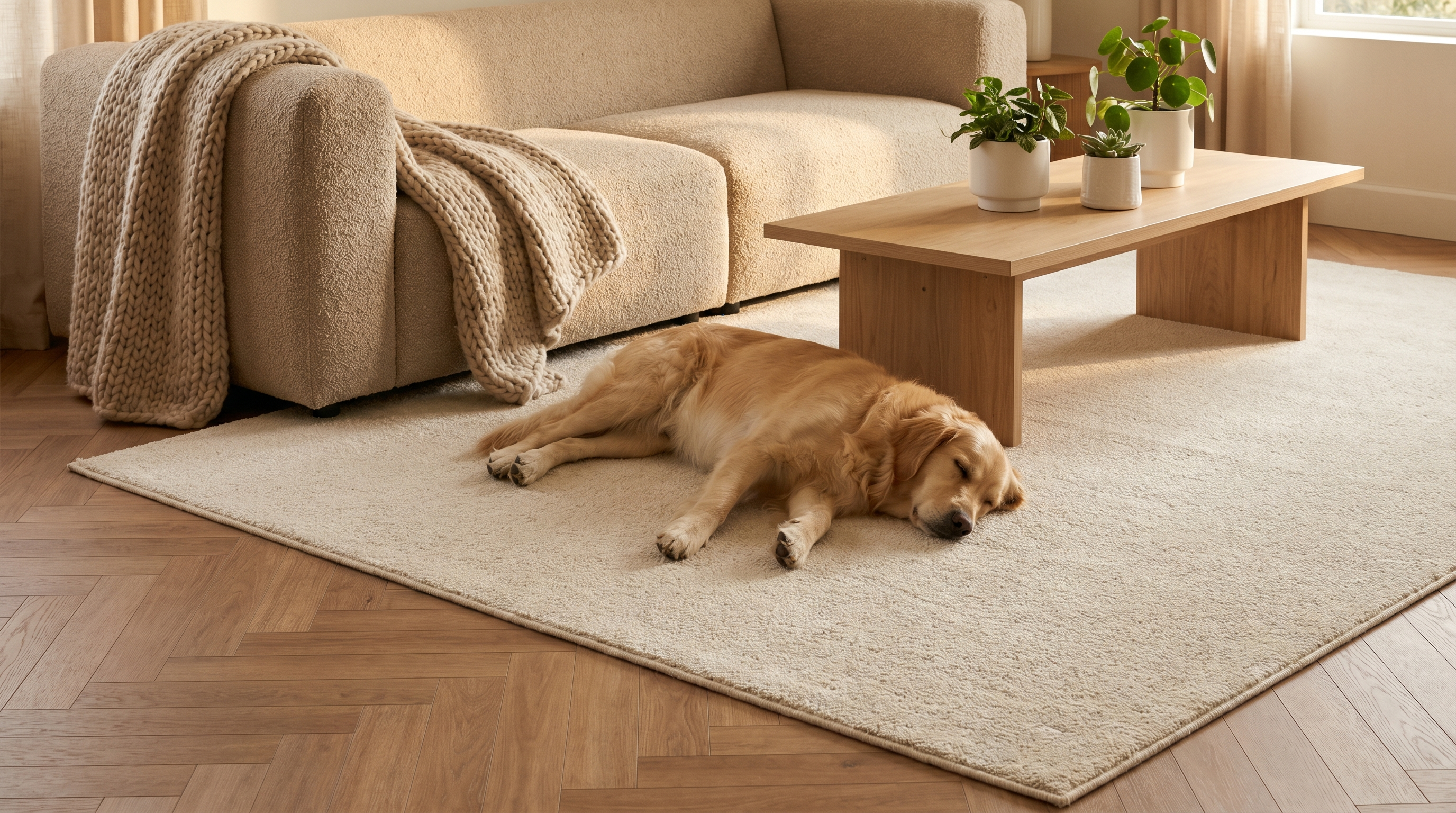
Sleeping spots. Dogs often sleep on the rug: the area compresses, the fibre flattens and skin oils build up.
To answer all five, a non-porous fibre plus a water-repellent treatment plus machine washability plus mechanical resistance are the four conditions you need together. That is exactly what the Easy Clean family offers.
2. Why Easy Clean designs are ideal
The Casemira Easy Clean tag identifies designs that combine four technical treatments at once:
| Treatment | How it answers the pet challenge |
|---|---|
| Machine washable at 30 °C | A quarterly reset that removes urine, smells and ingrained hair |
| Stain-repellent finish | Liquids (urine, water, saliva) stay on the surface, giving you several minutes to act |
| Non-slip backing | Safety for a dog that sprints or stops suddenly, with no rug sliding away |
| Scratch-resistant | A dense fibre that stands up to feline digging and mechanical wear |
All 57 Easy Clean designs are Oeko-Tex Standard 100 certified (free of harmful substances, which matters for the health of an animal in contact with it all day). The composition is consistently a cotton and polyester blend. Price range: 239 € to 549 €.
For the full detail of how it works, see our guide to Easy Clean rugs: the premium property of washables.
"With pets, the right rug is not the one you protect. It is the one that defends itself."
3. Protection against cat claws
Cats need to work their claws: it is instinctive behaviour tied to marking territory and keeping their claws in shape. Three features of Easy Clean limit the damage:
Density of construction. The very dense cotton and polyester fibre in Easy Clean designs offers greater mechanical resistance than standard polyester or polypropylene. Claws do not catch the weave as easily.
A balanced blend. Cotton brings resistance to tearing, polyester brings elastic flexibility. Combined, they take localised stress better than a single fibre.
A smooth, short pile. Easy Clean designs generally have a short or medium pile (5-12 mm), not shaggy. That structure reduces the purchase claws get on the fibre.
A limit worth knowing: no textile rug is completely invulnerable to the claws of a very active cat. If your cat works its claws on the rug as a matter of course (rather than on a dedicated scratching post), some behavioural training alongside is still advisable. An Easy Clean rug limits the damage; it does not remove the cause.
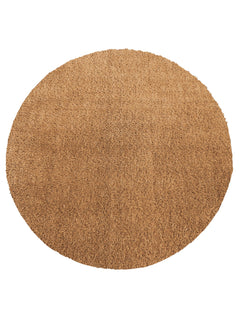
For Maine Coons or Norwegian Forest cats (breeds with powerful claws), go for short-pile designs (Vision, the round Vulcan) rather than heavily textured patterns.
4. Dealing with pet urine
Pet urine is one of the great textile challenges. The Easy Clean repellent finish changes the picture in stages:
Stage 1: prevention. The hydrophobic coating stops urine soaking deep into the fibre. The liquid stays on the surface, and you have several minutes to act instead of a few seconds on a porous fibre.
Stage 2: action. Blot immediately with a clean white cloth, without rubbing. Spray a mixture of equal parts water and white vinegar, which neutralises the acids and salts in urine and removes 90 % of the smell. Let it dry completely. Vacuum.
Stage 3: a deep clean. If the area still smells once dry, machine wash at 30 °C (Easy Clean designs take 1-2 washes a month with no visible deterioration). Use a mild detergent, no bleach and no fabric conditioner. Dry flat for 24-48 hours.
If it has soaked in deeply, follow the machine wash with a visit to a specialist rug cleaner (12-15 €/m²).
For general good practice on cleaning, see our guide to cleaning a rug.
5. Dealing with hair
The challenge varies with the breed and the season:
Normal season (short-haired animals). Vacuum three times a week in the direction of the pile, at moderate power. On Easy Clean designs, the smooth short or medium pile makes vacuuming easier: hairs do not work their way deep into the fibre.
Moulting season (spring, autumn). Vacuum daily for 2-3 weeks, ideally with a cylinder vacuum with a pet brush or an electrostatic brush. Combine that with regular grooming of the animal (2-3 times a week), which removes dead hair before it lands on the rug.
Long-haired breeds (golden retriever, Persian, Maine Coon). Vacuum the edges of the rug too, where hair collects. When seasonal shedding is heavy, machine wash the rug every 2 months through the moult.
A tip. For ingrained hairs the vacuum will not lift, run an adhesive roller over the area (an oversized lint roller from a supermarket) before vacuuming. Far more effective than five more passes with the vacuum.
What to avoid. Long-pile shaggy rugs (15-30 mm) are not recommended with long-haired animals. Go for short or medium pile Easy Clean designs.
6. Where the dog sleeps
When a dog adopts one part of the rug as its bed, several specific things happen:
Localised compression. The fibre flattens under repeated weight. Turning the rug 180° every six months redistributes the wear and lets the compressed area gradually recover.
Skin oils and smells. A dog's coat naturally deposits skin oils (sebum) on the textile. On a water-repellent Easy Clean fibre, those oils stay on the surface instead of soaking into the weave. A monthly machine wash is enough to remove them.
Scent marking. A monthly machine wash resets the smell completely.
A dedicated solution: put a small extra rug (an 80×150 cm washable one in a similar colour) exactly where the dog sleeps. That "sacrificial" rug can be washed separately and more often.
For very large breeds (mastiff, Newfoundland, Saint Bernard): allow for a dedicated 120×170 or even 160×230 Easy Clean as the sleeping area. It costs less than an equivalent dog bed and it goes in the machine.
7. Mistakes to avoid with pets
Mistake 1: choosing a non-washable rug in a pet area. Handmade wool, viscose and pure Tencel cannot go in the machine. In a household with lively animals, that is the wrong choice. Go for Easy Clean.
Mistake 2: using bleach to neutralise a smell. Bleach attacks the fibres and the dyes, and does not actually remove the smell of urine. Use diluted white vinegar and a machine wash instead.
Mistake 3: ignoring a wet accident. Urine left for an hour soaks into the latex backing and becomes almost impossible to remove. Always act within 5-10 minutes.
Mistake 4: choosing a long-pile shaggy with a long-haired animal. A combination that multiplies the problems. Go for a short or medium pile.
Mistake 5: washing every week. Very frequent washing accelerates the deterioration of the latex backing and the fibre. Monthly is enough, fortnightly during heavy moulting.
Mistake 6: forgetting to turn the rug. Without a 180° turn every six months, the dog's sleeping spot flattens permanently.
For the wider washable context, see our guides to machine washable rugs and Easy Clean rugs.
Three Casemira Easy Clean rugs
 Aubergine Shaggy Washable Rug - Sahel
 Anthracite and Red Vintage Washable Rug - Terrazzo
 Turquoise Abstract Washable Rug - Belize
8. FAQ: rugs and pets
Your questions about rugs and pets
Which Casemira rug suits a household with pets?
The 57 Easy Clean designs are the most forgiving option: 4 treatments combined, Oeko-Tex certified, a cotton and polyester blend, priced 239-549 €. The emblematic designs: Vision, Eden, Vulcan, Laiton, Terrazzo.
How do I get rid of a urine smell on a rug?
Blot without rubbing. Spray equal parts water and white vinegar. Let it dry, then vacuum. If the smell persists, machine wash at 30 °C or use a professional cleaner (12-15 €/m²).
How often should I wash a rug when I have pets?
Machine wash monthly in standard use, fortnightly during heavy moulting. Washing very frequently accelerates deterioration.
Will cats claw the rug?
The risk is limited on Easy Clean designs (scratch resistance). Provide a dedicated scratching post alongside. The rug limits the damage; it does not remove the cause.
Should I avoid shaggy with a long-haired dog?
Yes. The dog's hair tangles into the long pile (15-30 mm). Go for short or medium pile Easy Clean designs (5-12 mm).
How much does a pet-friendly Easy Clean rug cost?
The range is 239 € to 549 €. 160×230: 349-449 €. 200×300: 449-549 €. Klarna in 3 interest-free instalments with no minimum spend. Free returns within 30 days across 100 % of the catalogue.
Written by the Casemira team, based in Brittany. More about Casemira.