7 min read · Updated 18 June 2026
If you look at the technical specifications of the Casemira outdoor rugs, you will notice they all share one material: 100% polypropylene. That is neither a coincidence nor a marketing decision: it is the answer to a technical equation that every other fibre loses once you factor in the specific demands of outdoor life. To see why, you have to go a little way into the chemistry.
1. Why polypropylene saw off the competition
Three big families of fibre were tried outdoors before polypropylene took over: natural wool, cotton and jute (along with similar plant fibres). Each has limits that rule it out for outdoor use:
Wool absorbs moisture (up to 30% of its weight in water), which encourages mould and odours. It attracts moths, fades in UV, and turns heavy and awkward to handle after rain. Unusable in an open outdoor space.
Cotton absorbs even more than wool, does not stand up to UV (fading within weeks in a south-facing spot), and has no mechanical resistance to being walked on when wet.
Plant fibres (jute, sisal, coir) resist biological breakdown but soak up moisture, buckle, turn rough and grow mould over time.
Polypropylene, a synthetic fibre from petrochemistry, gets round all of those obstacles: non-porous, hydrophobic, UV-stabilisable, mechanically elastic. It is the fibre the whole outdoor rug industry has adopted over the past 25 years, and the Casemira outdoor rugs collection (around 30 models) rests entirely on it.
2. BCF versus Heat-Set Frisé
Two technical variants of polypropylene sit side by side on the outdoor market:
| Criterion | BCF polypropylene | Heat-Set Frisé polypropylene |
|---|---|---|
| Process | Bulk Continuous Filament: a continuous fibre extruded as a single long strand | Yarn heat-textured to create crimped curls |
| Feel | Smooth, dense, almost velvety | Looped, fuller, a wool-like effect |
| Abrasion resistance | Excellent | Very good |
| Stain resistance | Excellent (non-porous surface) | Very good |
| Colour retention | Excellent, UV-stabilised | Excellent, UV-stabilised |
| Ideal use | Exposed terrace, heavy footfall | A velvety look, sheltered balcony |
In the Casemira outdoor collection, most models are in flatwoven or braided polypropylene, and the two Kalista No. 2 runners are in Heat-Set Frisé. The specifications on every rug state the composition.
3. UV stabilisation during production
Not all polypropylenes are equal in the sun. An indoor polypropylene (the kind used for living-room rugs) fades within weeks in a south-facing spot. The difference comes down to UV stabilisation during production:
How it works. As the fibre is extruded, anti-UV additives are mixed into the molten mass (rather than applied to the surface afterwards). Those additives absorb UV rays and dissipate them as heat, protecting the fibre's molecular chain and the dye pigments.
What it means in practice. The colour of a UV-stabilised outdoor polypropylene can hold for years under direct exposure, by textile industry standards, where an unstabilised polypropylene would lose 30-50% of its saturation in a single season.
How to check. On the Casemira specifications, the word "outdoor" guarantees UV stabilisation (otherwise the product would not be in the outdoor collection). If in doubt, contact customer service by email at contact@casemira.com.
One important point. This UV stabilisation is what separates outdoor polypropylene from indoor polypropylene. So you should not use an indoor polypropylene rug outside even though the fibre has the same name: its UV properties are not suited to it.
"Outdoor polypropylene is not a rug you put outside. It is a rug designed outside."
4. Natural hydrophobia
Polypropylene's hydrophobia is not a surface treatment (the kind that fades over time). It is a chemical property of the fibre itself, and it never goes away.
How it works. The molecular structure of polypropylene forms no hydrogen bonds with water. A drop cannot soak into the fibre: it stays on the surface or runs by capillary action between the fibres until it drains onto the ground.
What it means in practice. After a shower, an outdoor polypropylene rug dries in 30 to 90 minutes depending on the weather (faster in sun than in shade). No musty smell, no buckling, no damage to the weave.
The advantage over water-repellent indoor rugs. A water-repellent indoor rug (the Easy Clean models, for instance) resists accidental spills thanks to an applied repellent treatment. But that treatment wears off with successive washes (peak effectiveness of 18-24 months by textile industry standards). Outdoor polypropylene, by contrast, is hydrophobic by nature, and therefore indefinitely.
For the wider picture on outdoor materials and durability, see the guides terrace outdoor rugs and the complete outdoor rug guide.
5. The Casemira outdoor models
The Casemira outdoor collection brings together around 30 models, all 100% polypropylene, all certified Oeko-Tex Standard 100.
Breakdown by shape:
| Shape | No. of models | Typical use |
|---|---|---|
| Rectangle | The vast majority | Terrace, balcony, standard pergola |
| Outdoor runner | Two (Kalista No. 2) | Path, poolside walkway, narrow terrace |
| Round | One (Soléa) | Under a round garden table |
Price range: the price depends on the size, up to 200 x 290 cm (the large outdoor size), and each product page shows the exact price.
Signature models: Kalista (plain grey or beige), Arido (plain sand, pearl grey or taupe), Tavola (boho, ethnic motifs), Dorio (camel, lines), Soléa (plain beige, also available as a round), Azura (blue and white, geometric motifs).
Casemira guarantees on outdoor rugs: free returns within 30 days, free delivery over €100, dispatch within 24 to 48 working hours, payment by card or PayPal, and Oeko-Tex certification on every model.
For care in detail, see the guide terrace outdoor rugs: materials and durability.
6. The limits of outdoor polypropylene
To stay honest, there are three limits of outdoor polypropylene worth knowing:
A synthetic feel. Polypropylene does not have the tactile warmth of wool or cotton. It feels dry and smooth (BCF) or synthetically looped (Heat-Set), perfectly suited to an outdoor space where you walk in shoes, but not comparable to a wool living-room rug under bare feet.
Sensitivity to extreme heat. Above a sustained 90 °C (prolonged full sun in a very hot climate, on concrete slabs that heat up), the fibre can begin to soften. For almost every French climate this is not an issue, but it is worth knowing for very exposed south-facing terraces in the south-west in summer.
Limited recyclability. Polypropylene is technically recyclable, but the recycling chain specific to textile rugs is still underdeveloped. That is the exact opposite of wool or Tencel, which have a stronger environmental case. For an indoor rug, see the guide 100% wool rugs vs 80/20 blends.
Our view at Casemira: these limits do not rule out outdoor polypropylene, which remains the only technically viable fibre for this use. But they explain why, for indoors, Casemira also offers other fibres (wool, viscose, washable cotton and polyester blends): the rooms you live in every day deserve a different approach to fibre.
Three Casemira rugs for outdoors
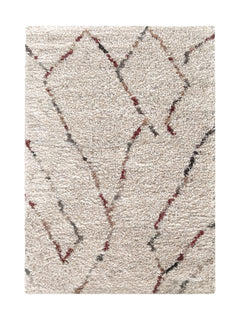
 Brown & Cream Berber Outdoor Rug - Kalista
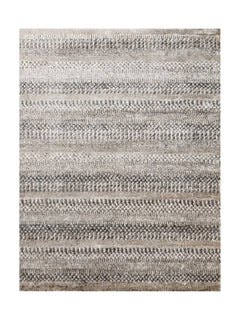
 Grey Berber Outdoor Rug - Tavola No. 02
 Blue & White Outdoor Rug - Azura
7. FAQ: outdoor polypropylene
Sizes for your layout
The right size depends on the area you want to dress and the furniture that will sit on the rug. Here are the practical benchmarks for the three common layouts.
5.1 Balcony (3 to 8 m²)
On a balcony, space is tight. Go for an 80x150 or 120x170 placed under a sun lounger, under a small bistro table or as a welcome zone at the balcony entrance. There is no need to cover the whole floor: leave 20 to 30 cm of margin at the sides so the space can breathe.
5.2 Terrace (10 to 25 m²)
On a standard terrace, the rug structures the outdoor seating area. Aim for a 160x230 or 200x290 under the outdoor sofa, applying the same rule as indoors: the front feet of the sofa on the rug. For an outdoor dining area, allow a rug that extends 60 cm all round the table with the chairs pulled out.
5.3 Pergola and large spaces (25 m² and over)
Under a covered pergola or on a large terrace, move up to the large 200x290 size, the largest in our outdoor collection. The rug becomes a genuine piece of furniture that sets the whole mood of the outdoor area. This is also the scale at which you can layer several rugs to create distinct zones (lounge, dining, reading).
"Outside is no longer an extension of the living room: it is a room in its own right."
Care: hosing down and brushing in 4 steps
The great advantage of an outdoor rug is how simple it is to look after, unlike indoor rugs in wool or viscose. Here is the routine that adds several years to its life.
6.1 Step 1: vacuum or shake it regularly
Once or twice a week, shake the rug out vertically to loosen the leaves, sand and dust that build up. If the rug is large, vacuum both sides on the "hard floor" setting. This simple step stops dirt from working its way into the fibres.
6.2 Step 2: clean it with a hose
Every one to two months depending on exposure, rinse the rug with a low to medium pressure hose. Avoid high-pressure washers, which can lift the backing or damage the fibres. Lay the rug on a flat, slightly sloping surface (a set of steps or a tarpaulin, for instance) so the water drains away easily.
6.3 Step 3: gentle brushing for stains
For localised marks (wine, fruit juice, bird droppings), use a soft brush and a little black soap diluted in warm water. Rub gently in the direction of the fibres, rinse thoroughly with the hose, then leave to dry flat. Avoid bleach and chlorine-based stain removers, which can lighten the colours.
6.4 Step 4: dry it before putting it back
After every clean, leave the rug to dry in the open air, ideally at a slight angle so any remaining water runs off. Allow a few hours in dry weather, longer in a damp season. Avoid putting a still-wet rug back on a tiled terrace: trapped moisture can stain the stone.
What to do in winter: putting it away and storing it
Even the toughest outdoor rugs last longer if you bring them in over winter, especially in regions with heavy rain, frost or snow. Three options, depending on your setting.
Full storage: roll the rug up thoroughly dry, secure it with a strap, and store it in a garage, a cellar or a utility room where it stays dry. This is the option that best preserves the fibres and the colours. Plan on doing it around mid-November, or at the first prolonged heavy rain.
Partial storage under a covered pergola: if your rug sits under an enclosed pergola or an awning that shields it from the weather, you can leave it in place and simply clean it less often.
Timing it to your local weather: in Brittany, on the Atlantic coast or in any damp area, it is better to bring it in from October. In Provence or around the Mediterranean, you can stretch it to December depending on the rain.
Your questions about outdoor polypropylene
What is the difference between indoor and outdoor polypropylene?
Outdoor polypropylene is UV-stabilised during production (anti-UV additives built into the fibre). Indoor polypropylene is not: it fades within weeks in a south-facing spot. Both are hydrophobic, but only the outdoor version stands up to UV over the long term.
BCF or Heat-Set, which should you choose?
BCF gives a denser, smoother feel, particularly suited to heavy footfall. Heat-Set Frisé has a looped, velvety look that is more striking. Both stand up to UV and moisture equally well.
Is polypropylene harmful?
No. Oeko-Tex Standard 100 certification, held by every Casemira outdoor model, guarantees that the fibre and the dyes contain no harmful substances.
How long does an outdoor polypropylene rug last?
By textile industry standards, 5 to 10 years in standard use with winter storage, longer in a moderate climate.
Can you leave an outdoor polypropylene rug out in the rain?
Yes, occasionally (polypropylene is hydrophobic by nature, drying in 30-90 minutes in the sun). For prolonged downpours or damp seasons, bringing the rug in extends its life. Storing it from November to March in a dry space is recommended.
Why does Casemira not offer recycled polypropylene for outdoor rugs?
The recycled polypropylene chain specific to rugs is still underdeveloped, and the fibre quality does not yet match UV-stabilised virgin polypropylene for this use. Casemira favours durability in use (5-10 years outdoors).
Written by the Casemira team, based in Brittany. More about Casemira.