7 min read · Updated 8 June 2026
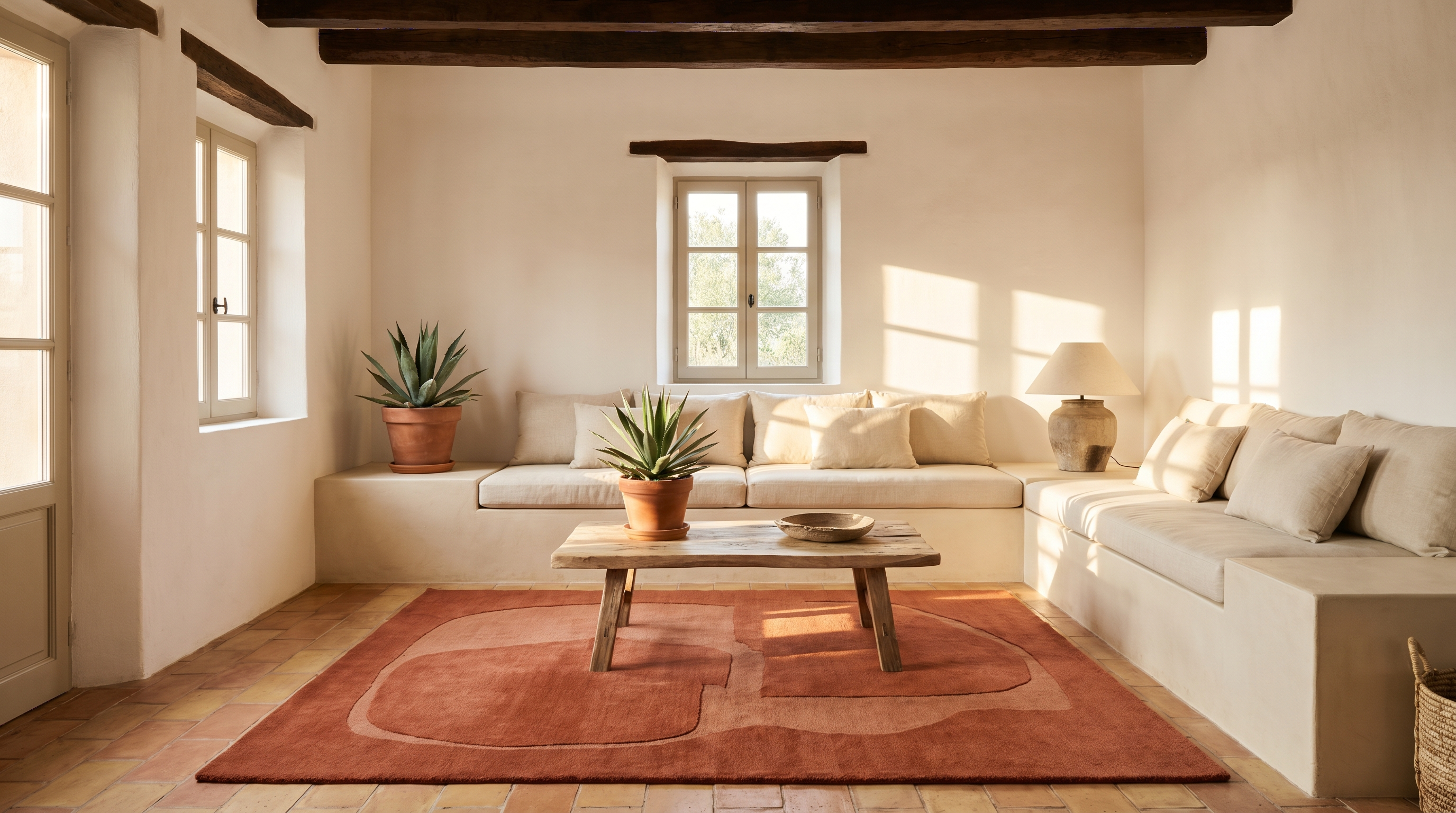
Terracotta has redrawn the decorating palette over the last five or six seasons. The colour of southern pottery, old quarry tiles and Italian burnt earth has become one of the great warm references of contemporary interiors. Why the success, which rooms does it really suit, and which designs let you bring it into a living room without a misstep? Here is the answer in seven points, with figures and designs to back it up.
1. Why terracotta took over interiors
Three things explain the rise of terracotta:
Fatigue with cool palettes. After years dominated by charcoals, off-whites and pearl greys, the eye goes looking for warmth. Terracotta delivers that warmth without tipping into garish reds or saturated yellows.
It echoes natural materials. Terracotta talks naturally to weathered wood, stone, veined marble, rattan and linen. It is a colour that calls for raw surfaces and matt finishes.
Its chromatic versatility. Unlike a sharp red or orange, terracotta accepts a very wide range of pairings. It works with forest green, teal blue, sand beige, white marble and wood both pale and dark.
In the Casemira catalogue the colour is represented by more than 80 references in the orange and terracotta rug collection, spread across every material: polypropylene (plain Ravello, Caspien design), polyester (washable Vulcan, vintage Vadi, Onyx), cotton (Vulcan), viscose (Botanica), wool and viscose (Estella), Tencel (Solara), wool and Tencel (Agata), and wool (including many Berber rugs).
2. The undertones of terracotta
Like beige and grey, terracotta is not one colour but a family of undertones. Three main profiles:
| Undertone | Character | When to choose it |
|---|---|---|
| Bright terracotta | Warm, luminous, faintly orange | A north-facing room to warm up, a Mediterranean mood, strong contrast |
| Brick | Redder, deeper, almost burgundy | A classic living room, a library mood, alongside cognac leather |
| Orange ochre | Yellower, softer, earthier | Warm Scandinavian style, earthy japandi, off-white walls |
On Casemira product pages, these three undertones are grouped under the label "Orange/Terracotta". To pin down the undertone of a design you like, a simple test is to compare the photo of the rug with a sheet of white paper held next to it. If the rug looks red, it is brick. If it looks yellow, it is orange ochre. If it looks balanced, it is bright terracotta.
For the designs that have one, a sample from €10 (20 x 30 cm, free delivery), deducted from your rug with the code you receive by email, lets you confirm the undertone at home before ordering.
3. What to pair terracotta with
Five pairings that make a terracotta scheme work:
Deep forest green. The most striking complementary pairing. Forest green offsets the warmth of terracotta and creates a Mediterranean woodland mood. It works particularly well with a terracotta rug under a forest green velvet sofa.
Teal or petrol blue. The contemporary art deco duo. Deep blue brings depth, terracotta brings warmth. The Solara in terracotta and blue Tencel plays out that logic within a single rug.
Sand beige and cream. A soft, Mediterranean pairing that works especially well in a bright room. Terracotta becomes the warm point in a neutral palette. Estella (wool and viscose) and Botanica (beige and terracotta viscose) both take this route.
Dark walnut and cognac leather. Terracotta gains in sophistication against deep brown surfaces. A library, club or warm mid-century mood.
Veined white marble and brushed brass. An upmarket, almost art deco pairing. Terracotta takes on a pared-back elegance, shown off particularly well in 200 x 300 in a large living room.
To go further into colour harmony, our guide to choosing a rug colour sets out the 60-30-10 rule and the difference between warm and cool undertones.
"Terracotta does not brighten a room. It warms it."
4. Mediterranean, boho and Scandinavian terracotta
Three registers in which terracotta particularly comes into its own:
Mediterranean. On old quarry tiles, ochre stone flags or a limewashed white wall, terracotta returns to its original colour. The washable Vulcan abstract in terracotta (a cotton and polyester blend) or the washable vintage Vadi in terracotta and blue deliver the look with no upkeep worries: machine washing at 30 °C, ideal in a room where you cook and entertain.
Boho. Terracotta talks to ethnic motifs, rattan, raw ceramics and green plants. The Caspien design in terracotta and grey (polypropylene) is an accessible way into this style. See also our guide to Berber-style rugs to explore how they complement each other.
Warm Scandinavian. On pale wood floors, against off-white walls and pared-back furniture, a terracotta rug supplies the warmth that classic Scandinavian restraint can lack. The Solara in taupe Tencel (with terracotta accents) and the multicoloured Estella in wool and viscose suit this use particularly well.
For a large living room, 200 x 300 remains the pivot size (guide to 200 x 300 rugs). For 160 x 230, see our dedicated guide to the 160 x 230 best seller.
5. Common mistakes to avoid
Mistake 1: saturating the room with terracotta. Terracotta walls plus a terracotta sofa plus a terracotta rug produce a stifling cave. Always balance with a neutral majority (60 % neutral, 30 % terracotta, 10 % accent colour).
Mistake 2: terracotta on an already ochre floor. On pale red wood (cherry, red-varnished beech) or intense quarry tiles, terracotta loses its legibility and the eye can no longer read the edge of the rug. Choose sand beige or cream for the same warmth.
Mistake 3: pairing terracotta with dusty pink. The two colours share a pink base, and the result reads as an incoherent gradient that denies terracotta its clarity.
Mistake 4: a warm undertone against a yellow wall. An ochre yellow wall plus a bright terracotta rug creates a uniform yellow-orange field. Go for brick terracotta (redder) or change the palette.
Mistake 5: going too small. Like every strong colour, terracotta needs real visual presence. In 120 x 170 in a 20 m² living room it simply floats. See our guide to choosing the right rug size.
6. The best Casemira designs (a selection)
The terracotta collection offers more than 80 designs, each with a distinct profile. A few key recommendations:
Small budget, versatile: Caspien in terracotta and grey (polypropylene) or Onyx, the washable black and orange design (polyester). Both are good ways to try the colour without a big commitment.
Busy family: Vulcan, the washable abstract in terracotta (cotton and polyester). Machine washable at 30 °C, with faded vintage motifs. Available rectangular and round. See also our guide to washable rugs.
Classic living room: Vadi, the washable vintage in terracotta and blue (polyester). An elegant faded effect on a brick red ground. At home in a period room or a contemporary one.
Refined living room: Estella in wool and viscose (in 160 x 230 and 200 x 300). A blend of fine fibres, with terracotta accents on a beige and cream ground. Shown off especially well in a large, bright room.
A signature couture piece: Solara in terracotta and blue Tencel or Agata in wool and Tencel in a special shape. Density, depth of fibre and a sophisticated interplay of colour.
Round: the plain orange round Ravello in heat-set frieze polypropylene for an intense bright terracotta, or the washable round abstract Vulcan in terracotta. Round rugs bring a formal softness to the floor.
To confirm your choice before buying, some designs are part of the selection of more than 120 designs offered as samples from €10 (free delivery), deducted from your rug with the code you receive by email. See also how to order a sample. For the other designs, free returns within 30 days make buying at a distance safe.
Three Casemira rugs for the living room
 Black & Orange Washable Rug - Onyx
 Beige & Terracotta Contemporary Rug - Verona
 Multicolour 100% Wool Rug - Dessau
7. FAQ: terracotta rugs
Your questions about terracotta rugs
Is terracotta too strong a colour for my living room?
Not if you balance it with a neutral majority. The 60-30-10 rule (60 % neutral, 30 % secondary colour, 10 % accent) keeps terracotta legible without saturating the room. If you are wary of committing, start with a medium size (160 x 230) rather than a large 300 x 400.
Which material should I choose for a terracotta rug?
For family use, polypropylene (Caspien) or washable polyester (Vulcan, Vadi, Onyx) take everyday life in their stride and go in the machine. For a refined living room, viscose (Botanica) or wool and viscose blends (Estella) give a shimmering finish. For a signature piece, Tencel (Solara) or wool and Tencel blends (Agata) offer exceptional depth of fibre.
What furniture goes with a terracotta rug?
Terracotta gets on particularly well with: cognac leather, forest green or teal velvet, dark walnut, veined marble, brushed brass, rattan and bamboo, raw ceramics. To avoid: tone on tone with dusty pink or a garish orange.
How much does a terracotta rug cost at Casemira?
Prices run from a small round Ravello to a large Solara in terracotta and blue Tencel. A 160 x 230 in polypropylene or polyester sits at the accessible end of that range, and a handmade 200 x 300 in wool or Tencel much higher. Each product page is the definitive reference.
Will terracotta age well?
Yes, and it is reputedly one of the most stable colours there is. Its pigment richness and its roots in the earth palette spare it the dated look that some seasonal colours acquire. According to textile industry standards, modern fibres (BCF polypropylene, Modal Silk, Tencel) hold their shades over time.
Can I test a terracotta rug before buying?
For the designs that offer one, among a selection of more than 120 designs, the sample from €10 (20 x 30 cm, free delivery) is deducted from your rug with the code you receive by email. For the other designs, free returns within 30 days let you try one at home with no commitment at all.
Written by the Casemira team, based in Brittany. More about Casemira.