7 min read · Updated 10 August 2026
Red is never incidental in a room. It decides. A red rug that works sets the room out as a decorative project straight away, shows off the furniture and signs the style. A red rug that fails flattens everything, tires the eye and stops the room breathing. The difference is not about price but about four precise rules that few shoppers know. Here is the method.
1. Red: a colour that decides
Three visual effects make red a special case in interiors.
It catches the eye first. Before the sofa, before the table, before the painted wall: red is what the eye sees first when you walk into the room. That makes it a powerful backdrop for the other furniture, provided that furniture is restrained enough to support the contrast.
It warms the room visually. A room with a red rug feels 2 to 3 degrees warmer than the same room with a beige or grey one, in purely subjective terms. A useful effect in a north-facing room or a living room with hard, cold light.
It signs the style. Unlike beige, which can go with any style, red steers the room: oriental, boldly contemporary, classic mid-century, art deco. You need to know which one you are after before you buy.
To compare with other signature colours, see black rugs: a design signature, contemporary grey rugs and terracotta rugs. For more neutral colours, see versatile beige rugs.
2. Burgundy, brick, ruby: 3 undertones
In interiors, the word "red" covers three very distinct shades.
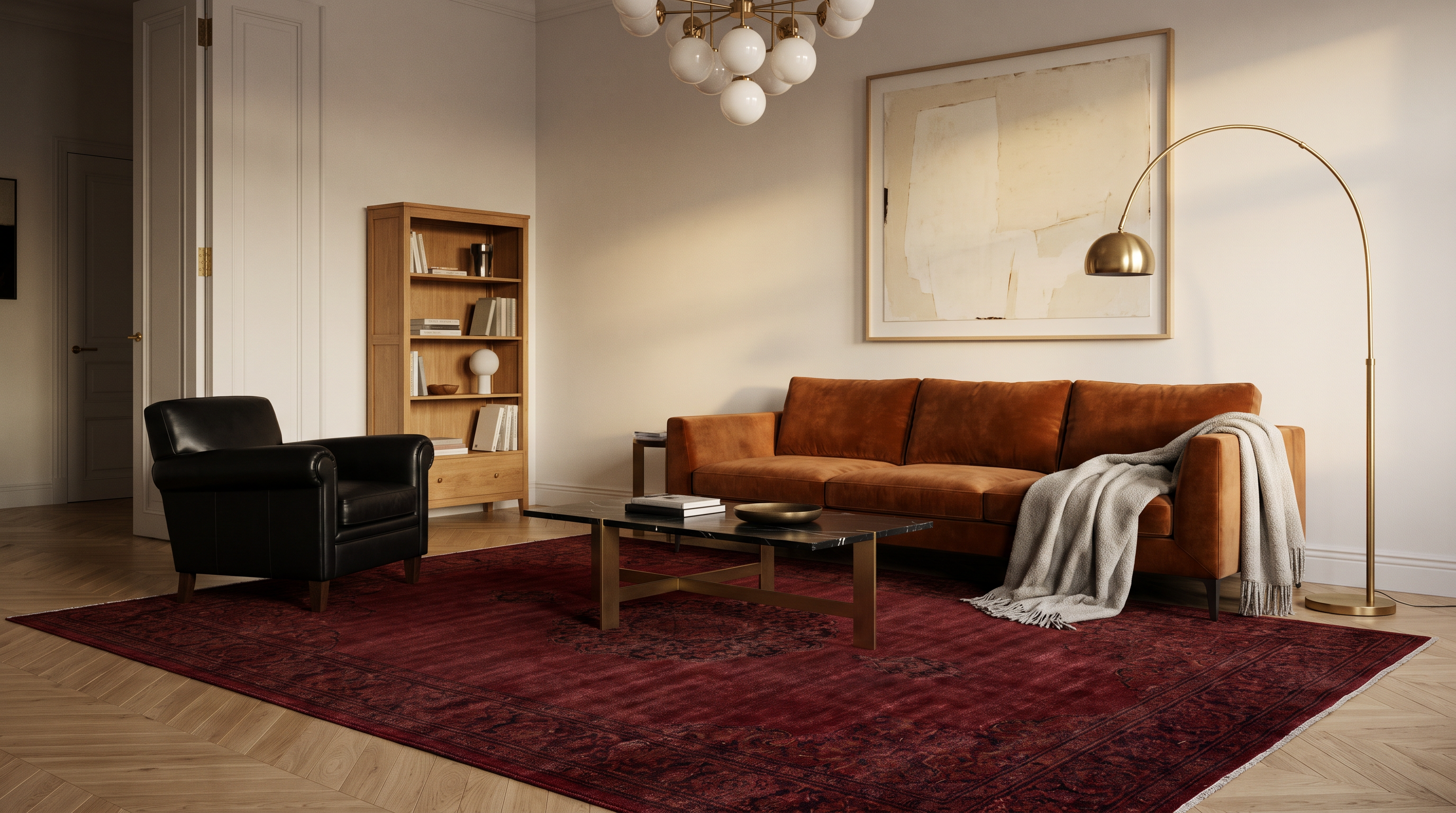
Burgundy (a deep red with a brown undertone). The most forgiving of the three, because its saturation stays under control. It weathers well with dark woods (walnut, wenge) and sits with cognac leather, bottle-green velvet and aged brass. Art deco, club, private library.
Brick (an orange red leaning towards pale terracotta). The warmest and earthiest. It pairs with pale wood furniture (oak, ash), off-white walls and handmade ceramics. Mediterranean, Scandi-boho, artisan studio.
Ruby (a bright, saturated red leaning towards violet pink). The most radical. Keep it for rooms with pale floors and walls, minimalist furniture and few other bright colours. Boldly contemporary, glamorous, a design signature.
In practice: if you are hesitating, burgundy is the most versatile. Brick is the warmest. Ruby is the most radical.
| Undertone | Character | Style it suits |
|---|---|---|
| Burgundy | Deep, with a brown undertone | Art deco, club, timeless |
| Brick | Orange, earthy | Mediterranean, Scandi-boho |
| Ruby | Bright, saturated, violet pink | Boldly contemporary, glamorous |
3. 4 rules for working it in
Whether a red rug succeeds in a room comes down to four rules of balance.
Rule 1: restrained furniture around it. If the rug is red, the sofa is not. The sofa is cream, taupe, pearl grey, sand beige, charcoal or cognac leather. The furniture around it should support the rug, not compete with it.
Rule 2: a narrow palette around it. The 60-30-10 decorating rule still applies, but in its strict version: red takes 30 to 40% of the visual impact through the rug, the other colours stay neutral (60-70%) with a single secondary accent (10%).
Rule 3: a pale floor or a pale reference wall. A red rug gives its best results on pale oak flooring, pale tiles or pale polished concrete. On a dark floor, or against coloured walls, it saturates the room visually and tires the eye.
Rule 4: go full size, not timid. A red rug in a small size looks redder still (the colour is concentrated). Better a large size that sets the room than a small one that jars. On sizing, see living room rugs for 15, 20 and 25 m² and rugs under the sofa: the 20 cm rule.
"Red is laid down the way a short sentence is spoken: once, firmly, and alone."
4. Motifs: plain, oriental or contemporary
Three families of motif among the Casemira red rugs.
The plain red rug (or very lightly patterned). Flat, matt or lightly textured. This is the most contemporary and radical option, ideal for signing a modern designer living room. Recommended undertone: burgundy or ruby. Casemira offers it in frieze-effect Heat-Set polypropylene (Ravello).
The oriental red rug. Floral motifs, a central medallion, an ornate border, and a palette of burgundy red plus beige and navy blue. This is the classic, timeless option, and it works even in a very contemporary interior through sheer contrast. Casemira offers this style in Turkish Heat-Set polypropylene across the runner collection and several oriental collections. See oriental rugs: a buying guide and high-density Persian rugs.
The contemporary red rug with geometric motifs. Abstract motifs, lines, blocks of flat colour. A good option for Scandi-boho interiors or a contemporary loft. Recommended undertone: brick for boho, burgundy for a loft. See modern and designer rug trends.
5. Materials and budgets
Casemira red comes in several materials, with very different budgets.
Heat-Set or BCF polypropylene (over 20 designs). Entry and mid-range. Stable solution-dyed colour (the red does not run and does not shift in indirect light), with abrasion resistance documented by the composition according to textile industry standards. Recommended for family living rooms and hallways.
Polyester (10 designs). Soft underfoot, and some machine washable at 30°C subject to the care label on that particular design. A good compromise between budget and comfort.
Persian-style designs: Samara in silk-effect modal and Isfahan in acrylic and cotton (8 designs). The top of the range. A subtle sheen and a fluid handle, ideal in a designer or signature living room.
Wool (over 40 designs, Berber and handmade rugs). The top of the range. High density, thermal insulation according to textile industry standards, and longevity documented by the composition. The most exclusive pieces reach several thousand euros. See 100% wool versus 80/20 blends.
6. The red Casemira designs
The Casemira red rug collection brings together over 80 designs.
| Feature | Detail |
|---|---|
| Number of designs | Over 80 |
| Price | Wide range of budgets |
| Wool (Berber and handmade) | Over 40 designs |
| Heat-Set or BCF polypropylene | Over 20 designs |
| Polyester (often in a washable blend) | 10 designs |
| Persian-style (silk-effect modal, acrylic and cotton) | 8 designs |
| Washable at 30°C | 11 designs |
| Built-in non-slip backing | 11 designs |
| Oeko-Tex Standard 100 certified | Over 10 designs |
| Main sizes | 80 x 150, 160 x 220, 200 x 300, 300 x 400 cm |
| Shapes available | Rectangle (over 70), oval and round (a few designs) |
Try before you buy. With red even more than with other colours, seeing the rug at home is invaluable, because red shifts noticeably between natural and artificial light. Samples are reserved for a selection (some of the handmade rugs, the Easy Clean range and a few outdoor rugs); for other designs, free returns within 30 days let you judge the shade at home.
Payment and delivery. Payment by card or PayPal. Free delivery on orders of €100 or more (€9.99 below that). Dispatched within 24 to 48 working hours, then delivered in about 2 to 8 working days depending on the country.
Return guarantees. Free returns within 30 days of delivery. See our returns and refunds policy.
Customer service. By email at contact@casemira.com.
Three Casemira rugs for the living room
 Grey & Red Modern Rug - Camden
 Anthracite and Copper Vintage Washable Rug - Terrazzo
 Plain Red Rug - Ravello
7. FAQ: red rugs
Your questions about red rugs
Which shade of red should I choose: burgundy, brick or ruby?
Burgundy is the most versatile (a brown undertone, timeless, art deco). Brick is the warmest (orange, Scandi-boho, Mediterranean). Ruby is the most radical (bright, boldly contemporary). If you are hesitating, burgundy is the most forgiving.
Which floor does red work best on?
A red rug gives its best results on pale oak flooring, pale tiles and pale polished concrete. On a dark floor (wenge boards, charcoal tiles) red saturates the room and tires the eye. To compare with other colours on pale floors, see black rugs as a design signature.
Does a red rug need a restrained sofa?
Yes, that is rule 1. The sofa should be cream, taupe, pearl grey, sand beige, charcoal or cognac leather. If the sofa is red too, the effect saturates and the room feels aggressive. Red takes the visual signature of the room; the furniture should support it, not compete.
Does red suit every room?
It works particularly well in a living room, a dining room, a generous entrance hall or a private library. It is trickier in a bedroom (a stimulating effect that can disturb sleep) and is best avoided in rooms under 12 m² (it saturates them). In bedrooms, prefer calming colours or red as a small secondary touch.
Can I test the shade before buying?
Yes, and it is particularly worth doing with red, whose undertones shift with the light. Samples are reserved for a selection of designs; for the others, free returns within 30 days let you judge the shade at home, in daylight as well as in the evening.
What should I budget for a good red rug?
At Casemira the red collection covers a wide range of budgets: it starts with small-format polypropylene and tops out with high-density wool or large-format silk-effect modal. Payment by card or PayPal. Free returns within 30 days of delivery. Customer service by email at contact@casemira.com.
Written by the Casemira team, based in Brittany, France.