7 min read · Updated 19 June 2026
A rug in the bedroom is one of the most telling decorative choices you can make: it transforms the mood, the comfort underfoot when you get up and the acoustics of the room. But where you place it in relation to the bed makes all the difference between a bedroom that breathes and one that looks poorly planned. Here are the three possible placements, worked out precisely for the four standard bed sizes.
1. The question of a rug under the bed
Three questions shape the choice:
What size is the bed? A single bed (90 x 190), a narrow double (140 x 190), a standard double (160 x 200) or a large bed (180 x 200 or 200 x 200). Each size calls for a different placement and an optimal size of its own.
How big is the bedroom? A 9-12 m² room (modest), 12-16 m² (standard) or 16-20 m² (large). The bigger the room, the more you can aim for a luxurious placement that surrounds the bed entirely.
What is the budget? The three placements cost different amounts: placement A (a rug that surrounds the bed) calls for a large size (200 x 300 or more), and therefore a higher budget than placement C (a rug crossways, where an 80 x 150 is enough).
For the wider bedroom picture (materials, colours, care), see our complete bedroom rug guide. The more than 900 designs in the Casemira bedroom collection cover every configuration.
2. Placement A: the rug surrounds the bed
The principle: the rug extends 50-80 cm beyond the three visible sides of the bed (front and both sides), with the headboard end left off the rug (against the wall).
The visual effect: maximum presence, a layered cocooning feel, and feet on the rug the moment you get up on either side. This is the luxurious placement par excellence, particularly effective in a main bedroom.
The maths by bed size:
| Bed size | Bed width | Rug width (bed + 2 x 60 cm) | Recommended size |
|---|---|---|---|
| 90×190 | 90 cm | ~210 cm | 200 x 300 cm rug at least |
| 140×190 | 140 cm | ~260 cm | 250 x 350 cm rug |
| 160×200 | 160 cm | ~280 cm | 250 x 350 or 300 x 400 rug |
| 180×200 | 180 cm | ~300 cm | 300 x 400 cm rug |
Rug length: the length of the bed (190 or 200 cm) plus 60-80 cm of margin in front of it, giving a rug length of 250-300 cm.
When to choose placement A: a bedroom of 14 m² or more, a standard or large bed, and a comfortable rug budget (a handmade 200 x 300 or 300 x 400 in a wool blend is a significant purchase, and 100% wool costs more still).
3. Placement B: under the lower two thirds
The principle: the rug starts at the upper third of the bed (just past the bedside tables or the headboard area) and runs to 50-60 cm beyond the foot of the bed. The lower two thirds of the bed sit on it.
The visual effect: very successful, and cheaper than placement A because the rug is smaller. Your feet land on the rug when you get up, but you are not standing on it when you sit down to put your shoes on (the bedside area stays on bare floor). This is the placement used most often in French bedrooms.
The maths by bed size:
| Bed size | Rug width | Rug length | Recommended size |
|---|---|---|---|
| 90×190 | 90-120 cm | 180-200 cm | 120 x 170 or 80 x 150 rug |
| 140×190 | 160-180 cm | 200-230 cm | 160 x 230 rug |
| 160×200 | 180-200 cm | 230-250 cm | 160 x 230 or 200 x 300 rug |
| 180×200 | 200-220 cm | 250-280 cm | 200 x 300 rug |
When to choose placement B: most bedrooms of 12-18 m². A standard or large bed. A mid-range budget (a handmade 160 x 230 in a blend, see our guide to the best-selling 160 x 230 rug).
"Placement B is the French balance: it makes an impact without overplaying it."
4. Placement C: crossways in front of the bed
The principle: the rug lies at right angles to the bed, in front of its foot, without going underneath. A long bedside-rug effect.
The visual effect: more modest, putting the emphasis on the foot of the bed (where you sit to put your shoes on, or watch television from the bed). Very well suited to modest bedrooms (9-12 m²) where a large rug on the floor would smother the room.
The maths by bed size:
| Bed size | Rug width | Rug length | Recommended size |
|---|---|---|---|
| 90×190 | 50-80 cm | 120-150 cm | 80 x 150 rug |
| 140×190 | 60-80 cm | 160-200 cm | 80 x 150 or 80 x 200 rug (runner) |
| 160×200 | 60-80 cm | 180-220 cm | 80 x 150 or 80 x 220 runner |
| 180×200 | 80-100 cm | 200-240 cm | 80 x 150 or 100 x 200 runner |
When to choose placement C: modest bedrooms (under 12 m²), studios, guest rooms and small children's rooms. A contained budget (an 80 x 150 in polypropylene or Easy Clean).
5. Special cases
Four configurations that fall outside the standards:
Twin beds (two separate 90 x 190 beds). Two options: one large rug surrounding both beds (a widened placement A, 250 x 350 minimum), OR two small 80 x 150 rugs laid crossways in front of each bed (placement C, doubled). The first is more harmonious, the second cheaper.
A mezzanine or cabin bed. The rug goes underneath the bed (on the floor), not on the platform of the cabin bed. A 160 x 230 or 200 x 300 depending on the size of the room, in placement A or B according to the floor space available.
A base without legs (ottoman bed, low bed). The rug cannot slide underneath the base. Only placement C (crossways in front of the bed), or a rug cut to the exact dimensions of the bed (which needs made to measure, offered at Casemira on handmade Berber rugs), are possible.
Two singles pushed together (forming one visually large bed). Treat it as a 180 x 190 or 200 x 190 bed depending on the total width, in placement A so the rug surrounds both together.
6. Size by placement
A summary to help you decide:
| Placement | Pivot size | Indicative budget | Ideal for |
|---|---|---|---|
| A (surrounds) | 250 x 350 or 300 x 400 | Higher budget, depending on material | Bedroom of 14 m²+, a luxurious main bedroom |
| B (two thirds) | 160 x 230 or 200 x 300 | Medium budget | Bedroom of 12-18 m², most situations |
| C (crossways) | 80 x 150 or an 80-100 x 200 runner | Small budget | Modest bedroom, studio, guest room |
To explore the sizes:
- The best-selling 160 x 230 rug (the most common placement B)
- The large 200 x 300 rug (a moderate placement A, or B with a large bed)
- What size of rug to choose (an overview room by room)
7. Recommended bedroom materials
The bedroom is one of the rooms where the feel under bare feet matters more than durability. Three families of materials suit it:
Pure wool or wool blends. That warm, springy feel is exactly what you want first thing in the morning. The more than 650 handmade wool designs at Casemira (the handmade rug collection) are perfect for a main bedroom. See New Zealand wool rugs for the specifics.
Viscose or viscose and wool blends. A lustrous finish, soft underfoot. Particularly successful in a bright bedroom where the morning light plays across the surface. The Estella design (wool and viscose).
Premium polypropylene or Easy Clean. For children's bedrooms or heavily exposed situations (pets sleeping in the room), the Easy Clean designs (four treatments combined, washable at 30 °C) offer maximum everyday tolerance.
What to avoid in a bedroom: cheap, heavily synthetic fibres (a dry, cold feel) and very busy motifs (a bedroom is a room for rest, so calm palettes work better). For soothing colours, see our guide to choosing a rug colour and our pieces on the versatile beige rug and the contemporary grey rug.
Three Casemira rugs for the bedroom
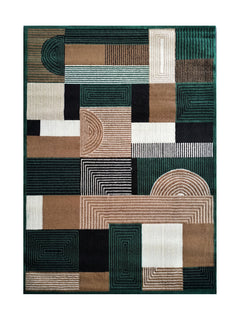
 Cream and Green Vintage Washable Rug - Terrazzo
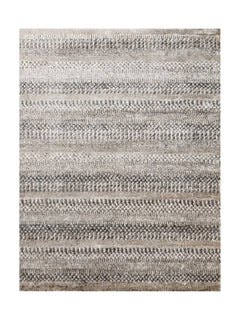
 Grey & Brown Polyester Rug - Capri No. 06
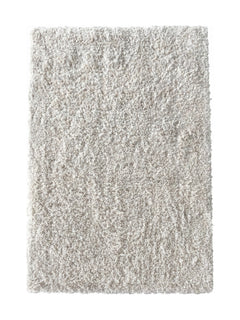
 White Shaggy Rug - Prismo
8. FAQ: rugs under the bed
Your questions about rugs under the bed
Which placement should I choose if I am unsure?
Placement B (under the lower two thirds) is the most versatile and suits 70% of French bedrooms. It offers an excellent cost-to-effect balance and works with a 160 x 230 (140 bed) or a 200 x 300 (160 or 180 bed).
What size of rug for a 160 x 200 bed?
In placement A: 250 x 350 or 300 x 400. In placement B: 200 x 300. In placement C: 80 x 150 or an 80-100 x 200 runner.
And for a 180 x 200 bed?
In placement A: 300 x 400 at least. In placement B: 200 x 300. In placement C: a 100 x 200 runner. For very large main bedrooms (20 m²+) with a 200 x 200 bed, aim for 300 x 400 as a minimum in placement A.
Which material works best in a bedroom?
A warm feel under bare feet comes first: pure wool, wool and viscose blends, or Tencel. For heavily used bedrooms, the Easy Clean designs cope well with daily life.
How much does a Casemira bedroom rug cost?
The price depends on the placement and the size across the more than 900 designs. A placement B in 200 x 300 polypropylene sits at the accessible end of the range, and a placement A in 300 x 400 handmade wool at the top. Each design's own page is the reference.
Is a rug under the bed a problem with a base that has no legs?
With a base that has no legs, the rug cannot slide underneath. Only placement C (crossways in front of the bed) is possible. Check the clearance under the base before aiming for placement A or B.
Written by the Casemira team, based in Brittany. Find out more about Casemira.